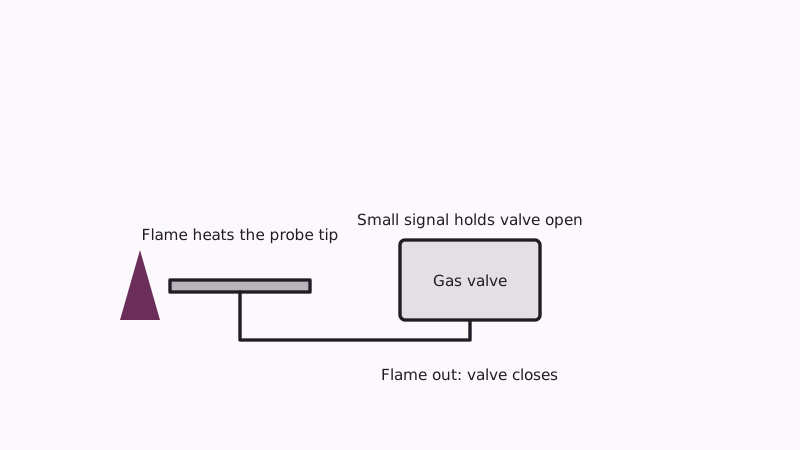
A gas tank that keeps losing its pilot is nearly always suffering from one small part. The thermocouple is a slim metal probe parked in the pilot's flame; as long as it stays hot, it vouches for the fire to the gas valve. Wear and soot weaken that vouching, and the valve shuts. Fixr lists a replacement with labor at $150 to $325. Other fixes are covered on the main water heater repair page.
What job does the thermocouple do in there?
Think of it as a lie detector for fire. Heat on the probe's tip generates a faint voltage that keeps the gas valve propped open. Flame gone means a cooling tip, falling voltage and a valve that snaps shut, so unburned gas cannot keep pouring toward the burner and out into your garage or closet.
That is also why a worn one can stop the heater while the pilot appears healthy: the signal has dropped below what the valve needs. Certain models use a thermopile, which strings several of these junctions together for a stronger signal, and plenty of newer heaters skip the standing pilot entirely in favor of electronic ignition.
What are the clues that this part has gone bad?
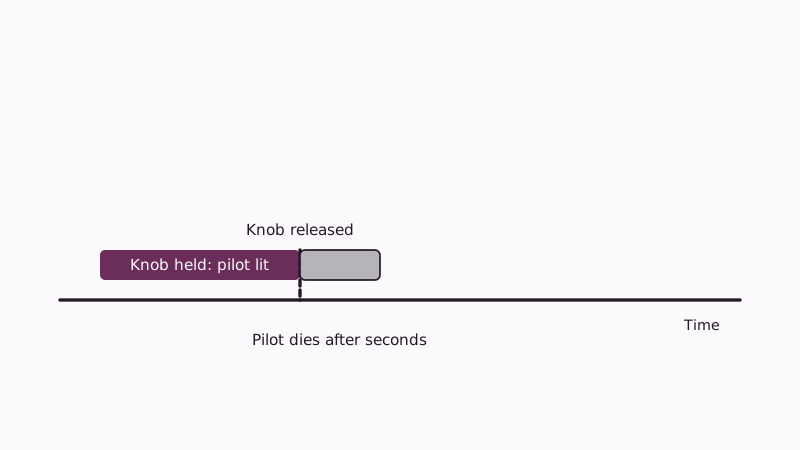
Classic pattern: the pilot lights only as long as the knob is pressed, then dies seconds or minutes after release. A bent, sooty or tired probe behaves exactly like that. A weak yellow flame, or a gust funneling past the burner, can imitate it, so the diagnosis is a plumber's call.
Safe observations only: is the pilot steady and blue, does it wrap the probe's tip, did the trouble begin after wind or after someone moved the burner cover? Follow the relighting directions on the tank's own label. After two careful attempts that fail, stop; repeated tries just release more gas around the appliance.
Smell gas at any point? Get everyone outside and avoid light switches or anything that sparks on the way out. Beyond the doorstep, the utility's line, 1-800-427-2200, takes leak reports, while 911 covers anybody at risk.
What should a replacement set me back?
Fixr's figures: $150 to $325 for the probe with labor, $75 to $175 for pilot repair, and a whole-repair spread from $150 to $750 with an average near $450. A call-out fee around $50 may be waived if you hire the visitor, and emergency surcharges can add $100 to $200.
| Repair | Guide range |
|---|---|
| New thermocouple | $150 to $325 |
| Pilot light repair | $75 to $175 |
| Gas control valve swap | $150 to $300 |
| Average of all heater repairs | $450 |
The part itself is cheap; most of the money covers the trip and the safety checks. These are national numbers; rely on the plumber's written quote for yours. If the control proves to be the culprit, replacing the gas valve costs more, and the repair price overview lines the options up.
Should an owner attempt the swap?
Better left to a plumber. The probe screws into the gas control, so you would be disturbing a gas appliance, and the state contractor board places gas appliances and their connections within the plumbing trade's classification. Many manufacturer manuals also tell owners not to service gas controls, so read yours.
The state's licensing threshold is a $1,000 total of labor and parts, and this repair lands well below that line, so the argument here concerns safety rather than price: a poorly seated probe or a leaking control fitting is a poor way to learn. If you still go ahead, close the gas at the appliance valve first and follow the maker's steps. Booking help takes a minute on the quote page.
Which other faults can snuff a pilot?
A gummed pilot orifice, a draught from a vent or garage door, a failing gas control, a sluggish supply or a blocked flue can each do it. A plumber works through these in turn. Soot around the burner or starved combustion air will also keep a pilot from holding.
Hard water enters indirectly. Anaheim reports hardness near 18 grains per gallon, and sediment collects in the tank bottom, so the burner works longer and its chamber grows dirtier over time. That is why a tank flush and a peek at the anode rod fit naturally into the same appointment; see anode rod replacement.
When does an old heater deserve a new thermocouple?
Generally if the tank base is dry and the heater is not yet ten. Rheem puts tank life at 8 to 12 years and favors a new heater when repairs would exceed half the cost of one, or when the tank itself weeps, since a holed tank is beyond repair.
A thermocouple failing on a twelve-year-old tank that also sends out rusty water or rumbles deserves a repair-versus-replace comparison. Look at how long heaters last and what a new one costs. Strapping and a city permit come with a replacement, not with a thermocouple swap.
Common questions
Does this heater of mine have a thermocouple at all?
Only gas models with a standing pilot do. Electric tanks rely on elements and thermostats, and many newer gas tanks use electronic ignition with a flame sensor. A small flame visible through a window low on the tank suggests a thermocouple or thermopile is sitting beside it.
How long will the visit take?
A swap tends to be a brief visit, though access, and any extra faults uncovered, can stretch it. When booking, ask for the expected time on site and whether the call-out fee gets credited to the repair if you proceed. Both answers should appear on the written quote.
Might a failing probe cause a gas leak?
The design works the other way: lost signal closes the valve. A gas smell points elsewhere, such as a leaking joint or control, and means leaving the building and phoning SoCalGas from outside. Never wait to see whether a smell fades.
Is there anything worth raising with the plumber while they are there?
Yes: ask about the relief valve, anode rod, tank sediment and earthquake straps. California Health & Safety Code 19211 requires heaters to be secured with bracing or straps. Raising a short checklist now spares you a second call-out later and gives you a fuller picture of the tank's remaining life.
This guide is one of many on Citrus Belt Plumbing.
Sources
Last updated