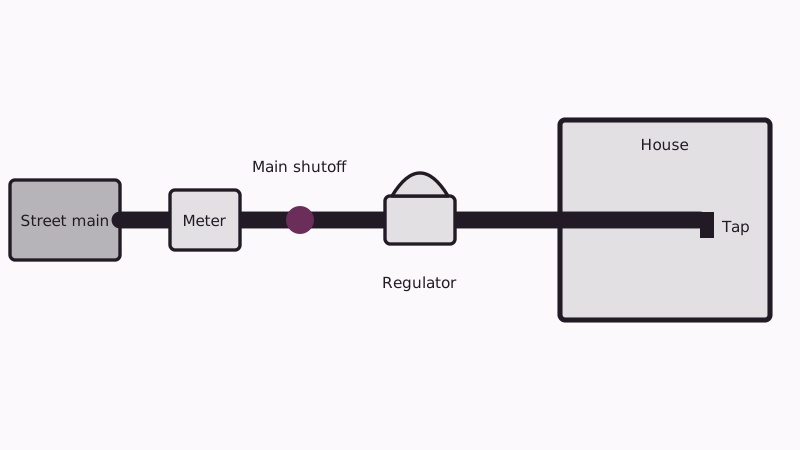
Thin, wheezy flow at the tap has a short suspect list in an Anaheim house: a valve opened only part way, a fixture plugged with grit, scale narrowing old pipe, a tired pressure regulator, or trouble upstream of your meter. One pressure gauge and ten minutes of testing usually names the culprit. Send a request through the quote form or from our home page. Below: the checks, the repairs and what they run.
How do I find out why my pressure is weak?
Start at the fixture and walk back toward the street. One weak faucet usually means a gritty aerator, which unscrews by hand. A weak bathroom suggests a stop valve opened only partway. When every tap is feeble, attach a gauge outdoors and inspect the main shutoff before blaming the pipes.
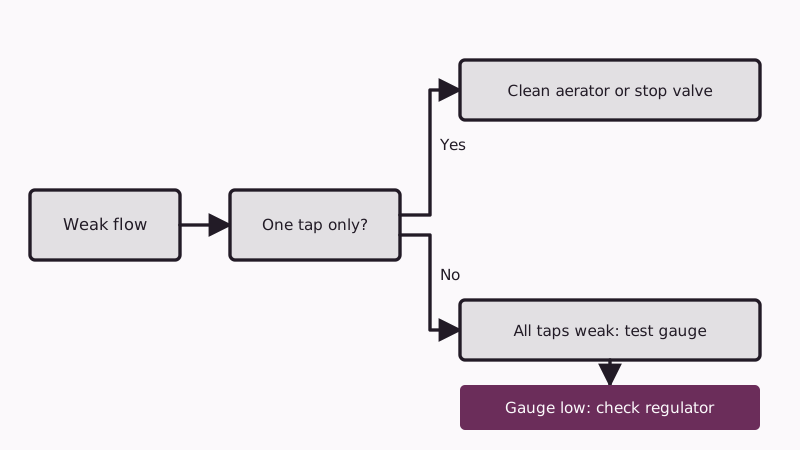
A homeowner can safely do these checks in about half an hour:
- Run hot, then cold, at one sink. Feeble hot alone implicates the heater and the valves around it; feeble on both implicates something upstream.
- Turn the house main and the meter-side valve fully counterclockwise. A valve left a quarter turn shy after old repair work fools many a household.
- Thread a gauge onto an outdoor spigot, confirm nothing indoors is running, and read the needle.
- Knock on a neighbor's door. If they are also weak, phone your water provider.
Cutting pipe or reaching into the regulator is the point to hand over to a pro. Each step is expanded in the guide to fixing low water pressure at home.
Why is only the shower or the bathroom sluggish?
Local weakness means a local cause. In a shower it is typically a showerhead choked with scale or a worn cartridge. At a sink it is the aerator. A bathroom that has lost flow across fixtures usually has a partly shut stop valve or a corroded section of supply line feeding that room. Hot water that lags behind cold often traces back to the heater.
Local water makes this worse. Anaheim's utility puts its hardness near 18 grains per gallon, hard enough to crust a showerhead white within months. Soak the head in vinegar for an hour and see if the spray returns. If it does not, the restriction sits deeper. Our pages on low pressure at the shower, hot water pressure and kitchen faucet pressure go fixture by fixture.
What makes pressure fall off overnight?
Overnight changes need an overnight explanation: a valve got bumped, a pipe let go, or the supply was cut for work. Think back to any visit by a plumber, landscaper or handyman. Scan the ground by the meter for dampness, a sign of a leak. If the whole block is weak, a city crew may be flushing or fixing a main, and flow generally recovers when they pack up.
Cold weather is a minor factor here. Winters are mild, so frozen lines are rare in Anaheim, Fullerton and Orange. A winter drop more often follows a pressure regulator that finally gave up or a main valve nudged during holiday work. Try this: shut off every fixture and look at the meter. A dial that still creeps means water is slipping away somewhere, and that is a leak call rather than a pressure call. A wider list of suspects waits at causes of weak household pressure.
What does a home pressure regulator do, and where is mine?
The regulator, sometimes labeled a pressure-reducing valve, is a brass fitting, shaped a bit like a bell, that trims street pressure before it enters the house. California's plumbing code calls for one whenever the supply would otherwise top 80 psi. Check just downstream of the main shutoff, near the spot the pipe comes into the structure, often by a front spigot or on a garage wall.
Street pressure can run well above what household pipes and fixtures like. The regulator holds the house at a steady setting well under the code ceiling. When its internal diaphragm wears out, two things can happen: pressure climbs, which stresses fittings and the water heater, or it falls, which is the weak-flow symptom people notice. Published guides suggest these valves last roughly 7 to 15 years.
Terrain matters here. A house tucked below the high ground in Anaheim Hills or Yorba Linda begins with plenty of static pressure, since water gains roughly 1 psi per 2.3 feet of descent, so it leans hard on a healthy regulator. For placement tips, see where a regulator is located, and the whole-house regulator page covers setup.
Can I adjust or replace the regulator on my own?
A careful owner with a wrench and a gauge can adjust one: back off the lock nut, nudge the screw, and recheck. Replacement is another matter, since it means closing the main, opening the line and often adding an expansion tank. Check with your city's Building Division on permits before you begin.
If you replace the valve, buy one rated for your pipe size and make sure it carries the ASSE 1003 mark that the plumbing code references. A regulator on a line with a water heater generally brings a thermal expansion tank into the picture, because pressure has nowhere to go when the heater cycles. Leave the tank out and the heater's relief valve is likely to start weeping. Adjustment steps are on pressure regulator valve adjustment; swapping the whole valve is covered in regulator replacement.
What does a pressure fix cost around Anaheim?
Angi's national guide puts a regulator swap by a plumber at $200 to $700 for most homes, with an average near $400, and Plumbinguide lists the valve itself at $50 to $150. Labor depends on access to the valve. Cleaning aerators or a showerhead costs next to nothing. Replacing corroded supply pipe is a bigger project priced separately.
What shifts the price:
- Access. A valve wedged into a cramped crawl space or a buried meter box costs extra labor.
- Extras. A new main shutoff, an expansion tank or pipe repair at the connection adds parts.
- Cause. Scale in old galvanized pipe cannot be flushed out; the usual remedy is a repipe.
These numbers are a guide. The visiting plumber gives the final figure once your pressure has been measured. More on this in the regulator installation cost guide. When the pipe itself is the issue, galvanized pipe replacement explains that route.
Who fixes it in a condo or an HOA community?
In a condo or townhome, the shared main and the regulator that serves the building are often the HOA's responsibility, while the pipes behind your wall are yours. Ask your property manager before touching a valve in a common utility room. Report a building-wide drop to the HOA first, since one repair on the shared line may restore every unit.
Inside your own unit the same rules apply: check the stop valves, the aerators and the water heater, and hire a plumber for anything in the walls. Some associations require approved vendors or advance notice for work that shuts off water to neighbors, so ask before you schedule a visit.
Common questions
What pressure should a well tank be set to?
Most private-well systems run a switch that starts the pump near 40 psi and stops it near 60. Many homes in our cities take city water and never need this. If yours has a tank, the air charge is normally set about 2 psi below the pump's start pressure, measured with the tank drained. See low pressure from a well.
Does a sprinkler system need special pressure?
Yes. Sprinkler heads are designed for a working pressure range, and low pressure leaves them dribbling instead of spraying. If the lawn heads fail while the house is fine, check the valve, the backflow assembly and any clogged filter on the irrigation line before blaming the supply. A plumber can also measure pressure on the irrigation branch.
Who do I call when pressure is low in my whole area?
Call your water provider, not a plumber. Anaheim customers deal with Anaheim Public Utilities, and Fullerton, Orange and Brea each run their own water divisions. They can say whether a main is being repaired or a pressure zone is being adjusted. If the provider reports normal pressure at the street, the cause is behind your meter.
Why do plumbers keep suggesting a pressure regulator test?
Because it takes two minutes and rules out the most common failure. A hose-bib gauge reading well above or below the normal household range points straight at the regulator, saving hours of guesswork inside the walls. A reading above 80 psi is the level where California's plumbing code expects a regulator to be in place.
Will I be without water while the regulator is swapped?
Yes, for the duration. Expect a morning or an afternoon, provided the valve is reachable and the shutoff still turns. A seized shutoff, a corroded union or a buried meter box can stretch that. Fill a pot or two beforehand and schedule the visit around laundry and showers.
More in this guide
- Water pressure and valves
Fix weak water pressure at home in the order that saves money: valves, aerators, scale, the regulator, then a booster pump.
- Water pressure and valves
When a failing pressure regulator needs replacing, how the swap is done, what code expects (80 psi, strainer, expansion tank) and what it…
- Water pressure and valves
Low pressure from a private well comes down to the pump, the pressure tank, the switch or a clog.
- Water pressure and valves
Where to find a home water pressure regulator in Anaheim and North OC houses, what it looks like, how to test it, and what to do about an…
- Water pressure and valves
What a whole-house water pressure regulator does, when the California Plumbing Code calls for one, where it sits, how it is set and what…
- Water pressure
Step by step: test your psi with a gauge, adjust the pressure regulator screw in small turns, and know when a failing valve needs a…
- Water pressure
Typical cost to install or replace a water pressure regulator: about $200 to $700 nationally, what pushes a job higher, and how to get a…
- Water pressure and valves
Weak water pressure at one tap, only hot water, or the whole house?
Sources
Last updated