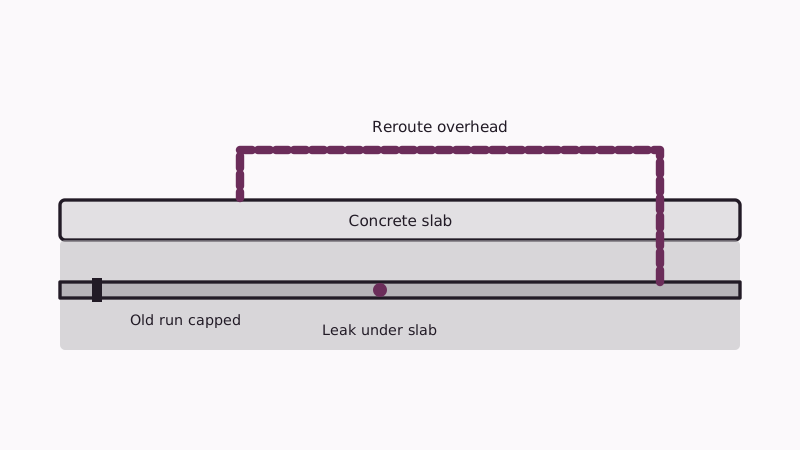
A single leak in newer, sound pipe is often worth patching where it sits. Two or more leaks, pipe that is going thin, or a plan to stay in the house for a long time tip the balance toward rerouting or repiping. The decision is about the pipe as a whole, not just the one wet spot. This page sits under our burst pipe plumber section and sets out how the three routes differ.
What are my three choices once a slab leak is confirmed?
You can repair the pipe at the leak, abandon the slab lines and run new ones through the attic or walls, or replace the whole plumbing system. Spot repair is the cheapest and fastest. Rerouting avoids the concrete for good. A full repipe also retires old pipe elsewhere in the house.
In a bit more detail:
- Spot repair. Access the pipe by cutting a hole in the slab, or by tunneling beneath it from outside, then fix the break and patch the concrete.
- Lining. A resin coating is pushed through the pipe to seal the inside. Some plumbers offer it, and not every building department treats it the same way, so ask first.
- Reroute. The dead slab line is capped and a new line runs overhead. Done to the affected branches only.
- Repipe. The whole supply system is replaced, typically in PEX or copper.
How does the cost compare across the three?
One published guide treats $1,000 through $4,000 as the normal span for a repair, while rerouting or repiping lands well above, with the top near fifteen thousand dollars and the floor around four thousand. Inside the repair span it prices opening the slab at $500 through $3,000, tunneling in at $900 through $2,000, and lining at $500 through $2,000.
| Route | Guide range |
|---|---|
| Leak detection | $100 to $400 |
| Spot repair, slab broken open | $500 to $3,000 |
| Tunnel from outside | $900 to $2,000 |
| Epoxy or resin lining | $500 to $2,000 |
| Reroute or repipe | from about $4,000, topping out near $15,000 |
These are national figures and wide, because concrete thickness, soil, flooring and pipe material all move the price. Only a plumber's written quote is firm. Itemized figures live on the slab leak cost page and the whole-house repipe price page.
When is a spot repair enough, and when is it throwing good money after bad?
Patch in place if this is the first failure, the copper nearby looks healthy and nobody plans a remodel under that floor. Move to a reroute or repipe when leaks keep returning, the pipe is visibly corroded, or you have already paid for two repairs. Each hole in the slab costs money and weakens trust in what is left.
Water chemistry plays a part here. Anaheim's published hardness is near 18 grains per gallon, and cost guides name water chemistry and pipe age among the factors in how slab pipes wear, so a house with hard water and aging copper may see more than one failure. A plumber who cuts out a section gets a look into the pipe, and a thin, pitted wall is the strongest signal that more leaks are coming.
Which method works best when the whole house sits on concrete?
Most slab-house repipes avoid the concrete entirely. New PEX or copper runs through the attic, down inside walls, and to each fixture, while the old lines under the floor are capped. It is called rerouting because the plumber follows a new path instead of replacing in the same trench.
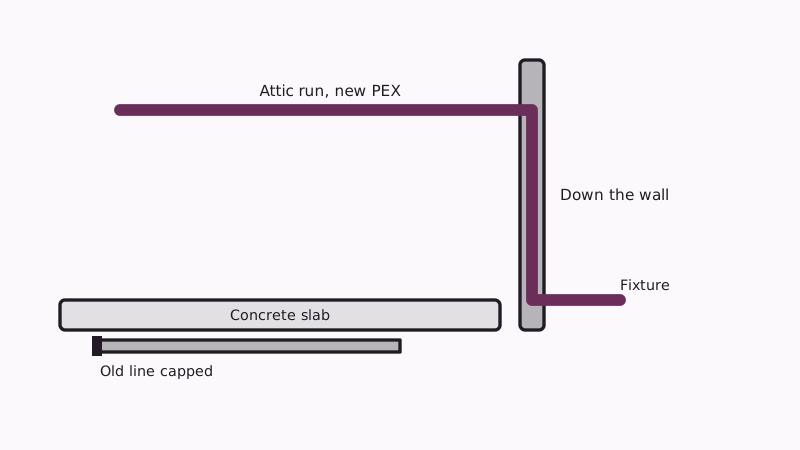
That approach limits breaking concrete to a few small openings. The tradeoff is drywall: walls get opened and patched, and paint matching is usually separate. Plan on several days of work and water off for much of each day. A permit through your city's building division normally comes with the job. Pipe choices are compared at PEX against copper, and the step sequence is laid out in the repiping walkthrough.
How do I know the leak is under the slab?
Look for one warm patch underfoot, a faint rushing noise while every tap is closed, a bill that rises for no reason, flooring that damps or lifts, and a meter dial that creeps. EPA's check is easy: write down what the meter shows, keep faucets and appliances idle across about two hours, then look again. If the dial advanced, water is leaking out somewhere.
A creeping meter proves loss, not location. Plumbers commonly use listening gear and thermal cameras to pinpoint the spot before any floor is cut, and guides price that detection step separately at $100 to $400. Gas lines may also cross the slab. Smell gas? Everybody leaves first, then, standing well clear of the building, dial the gas utility on 1-800-427-2200; reserve 911 for real danger.
Does homeowners insurance help with either route?
Often just partly. A cost guide reports that standard home policies generally skip the slab pipe repair itself, though resulting water damage is sometimes covered, and wording varies. Phone the insurer before work begins, hold on to the plumber's report and photograph the damage.
Policies differ on what counts as sudden versus gradual and on access costs like breaking concrete. Our guide on slab leak coverage goes through the questions to ask.
Common questions
What about a leak through a concrete roof slab?
That is a separate problem. Rain getting via a flat concrete roof or deck calls for a waterproofing or roofing contractor, not a plumber. In plumbing, a slab leak is a pressurized supply pipe beneath a house's floor slab. Unsure which you have? The meter check separates them.
Could I handle the repair on my own?
Seldom. Cutting concrete can strike gas, electrical or other buried lines, and the state's contractor board wants a license when labor and parts together hit $1,000. Homeowners can run the meter check and close the water; the digging and pipework belong to a plumber.
Roughly how many days will each option take?
Expect one to two days for a spot fix, followed by concrete curing and new flooring. Rerouting or repiping typically stretches across several days. A good estimate names the schedule and says how many hours each day the taps will be dry.
What should be asked before agreeing to a price?
Confirm whether the figure covers detection, the permit, concrete patching and drywall, and what the plumber saw in the pipe that was removed. Ask for the repair, reroute and repipe options priced side by side. The quote page starts that process, and each visit comes with a written estimate.
More services are listed on plumber in Anaheim.
Sources
Last updated