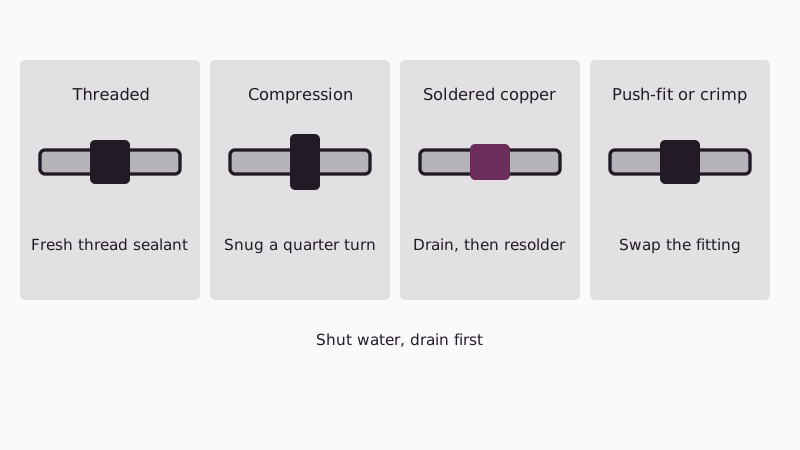
Before any repair, close the water supply and drain the line, because almost no joint can be fixed while it is under pressure. After that, pick the remedy by joint type: a snug-up for a compression nut, fresh thread sealant on a threaded joint, a resolder or new coupling in copper, a cut-and-reglue in plastic, a new push-fit piece where those are used. Anything out of reach, or unidentifiable, is for a plumber, and the burst pipe plumber page deals with urgent leaks.
Gas is another matter altogether. If the joint carries gas, stop reading, head outdoors and call SoCalGas, whose line is 1-800-427-2200. Add 911 where anyone is threatened. Gas piping is never a patch-it-yourself item.
What kind of joint is it?
Look at the fitting. A threaded joint shows a coupling or elbow with the pipe screwed into it, typical of galvanized steel and black iron. Compression fittings pair a big nut with a brass sleeve inside. Soldered copper joints are smooth collars edged with a silvery bead. Glued plastic shows a solvent seam, and push-fit or crimped PEX connections carry a plastic collar or a metal band.
Identifying it matters because a fix that suits one fails on another. Older homes in Anaheim, Fullerton and Orange may have galvanized threaded lines, where a joint leak often means the pipe is corroding from the inside, and postwar homes frequently have copper with soldered joints. Rust streaks, flaking or a bulge around a threaded joint suggest the entire run is tired; galvanized pipe replacement covers what to do next.
What do I do about the water coming out?
Turn off the nearest shutoff or the main, then run the lowest faucet in the house until the pipe empties, and park a pot and towels beneath the drip. Keep water clear of outlets and of the water heater's controls. Wiping the joint dry lets you see precisely where the moisture starts.
A leak that appears only at one point on the joint, a weep rather than a spray, points to a failed seal, not a broken pipe. Take photos before you disturb it, since they help if you later call a plumber or an insurer. For a spraying or fast leak that you cannot close off, treat it as an emergency; the emergency plumber page can help.
What stops a threaded joint from weeping?
The durable cure is to unscrew it, scrub the threads, apply new sealant (PTFE tape wound clockwise, or a drinking-water-rated pipe compound) and reassemble snugly, since over-tightening cracks fittings. When taking it apart is not possible, a temporary patch can slow things: plumbing epoxy putty, a pipe clamp or self-fusing tape on a clean, dry, unpressurized joint.
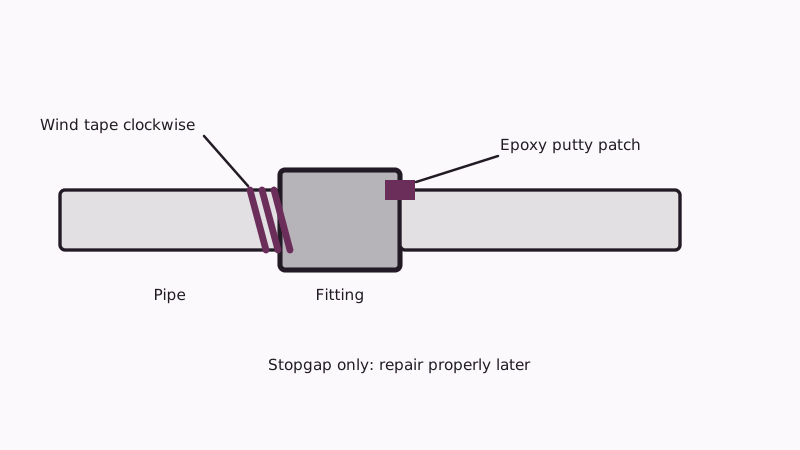
On the common question of fixing a threaded joint without removing it: yes, a stopgap is possible, but treat it as temporary. Dry the joint, rough up the metal, press epoxy putty around the seam per the label, let it cure fully, then restore pressure slowly. These patches sometimes hold for a long time and sometimes fail within days, depending on pressure, temperature and corrosion. Flag the joint for a proper repair.
Never try to seal a threaded gas joint with tape or putty.
What about compression, soldered and plastic joints?
A compression joint frequently quits dripping after a small nudge of the nut, and failing that, a replacement ring. A soldered copper joint requires a completely drained, dry pipe before a plumber reheats it or cuts in a coupling, and that torch work carries fire risk. Glued plastic gets cut out and replaced. Push-fit and crimped PEX fittings are normally swapped, not patched.
A closer look at each:
- Compression: snug the nut a little, never more than a quarter of a turn. Still wet? Close the supply, undo it and look at the ring.
- Soldered copper: water inside the pipe prevents the solder from flowing, so the line must be dry. Resoldering needs open-flame work near wood framing, a good reason to hire it out.
- PVC or CPVC: remove the joint with a saw and glue in a coupling using the solvent cement made for that plastic. Our guide to stopping leaks from plastic pipe goes further.
- PEX with crimp or clamp rings: the ring is cut off and a new fitting installed with the right tool.
- Push-fit: the fitting is released with a disconnect tool and replaced.
Is this mine to repair, or a plumber's job?
Reasonable to try yourself: an exposed joint with a slow weep, sound pipe, and a shutoff you can close. Bring in a plumber for corroded pipe, a joint buried in a wall or ceiling, a leak that sprays, or several joints leaking at once. A leak that keeps coming back signals a failing line and not just a bad seal.
On the contractor side, the state expects a license at $1,000 and on any permitted job; a minor joint repair rarely meets either test, whereas pipe replacement can. Walls and ceilings that need to be opened raise the stakes. The leaking water pipe repair and leaking pipe under a sink guides cover specific cases.
What does an unfixed leak cost?
Water damage, mold and a bigger bill. The EPA figure for a typical household is more than 9,300 gallons lost to leaks in a year, and a joint weeping for weeks can wreck drywall, flooring or cabinets. A repaired joint that drips again means the line is the problem; ask a plumber to quote replacing that section and to test the pressure.
If the damage is already significant, insurance and burst pipes explains why prompt repairs matter for a claim.
Common questions
Can plumber's tape fix a leaking joint?
Just on threaded joints, and only if it goes on while the joint is rebuilt. PTFE tape seals threads; it cannot help a crack, a soldered joint or a compression fitting, and wrapping it outside a leak is a weak stopgap. For a temporary hold, buy tape sold specifically for pipe repair.
Why does my pipe joint leak after I tightened it?
Overtightening can crack a fitting or crush a washer, and a corroded pipe may be too thin to seal. Old thread sealant can also be the culprit. Remove the joint, inspect the threads and the fitting for damage, and replace parts that look worn. If the pipe itself is thin, cut it back.
Is it safe to leave a slow drip until the weekend?
A slow weep can be tolerated with a bucket underneath and the valve closed whenever you are out, though damp framing invites mold and rot, so look at it daily. A faster drip, anything near electricity, or a hot-line source means shutting it off and phoning.
Does tightening or redoing one joint need paperwork?
Redoing a leaking joint is normally a repair, distinct from new piping work. Swapping out lengths of pipe is another story and can need a permit in Anaheim, so check with the Building Division when unsure. The Citrus Belt Plumbing home page explains how a plumber visit is arranged.
Sources
Last updated