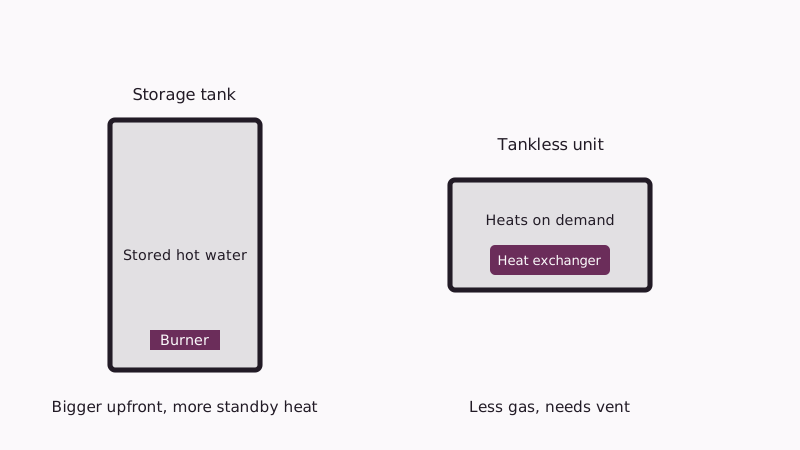
Short version: the tank is the cheaper box to buy and the easier box to swap, while the tankless unit sips less gas and outlives it, provided the house can feed it. Energy Department testing shows the saving ranging from roughly a quarter to a third for light users, shrinking to between 8 and 14 percent for big households. For fixes rather than a fresh purchase, start with the water heater service page.
Which kind of heater suits a house in Anaheim or Fullerton?
Choose a storage tank when upfront cost matters most, when the closet is small and when the gas pipe or electric panel has no room to grow. Choose tankless when daily hot water use is moderate, you expect to stay put for ten years or more, and a vent can reach an outside wall without surgery on finished rooms.
Use this as a sorting aid:
| What you have | Leans toward |
|---|---|
| Couple, one or two bathrooms, long-term owners | Tankless |
| Big household, laundry and showers stacked together | Tank, or a pair of tankless units |
| Cramped closet, half-inch gas pipe, no vent path | Tank |
| Garage unit with an exterior wall right behind it | Tankless |
| Plans to sell soon | Tank, the smaller outlay |
Guessing is unnecessary: eyes on the gas pipe, the vent route and the panel settle it.
How much gas does going tankless really save?
Energy Department numbers: for a home drawing 41 gallons daily or fewer, a gas on-demand heater needs roughly a quarter to a third less energy than a storage tank (24 to 34 percent); at 86 gallons daily the cut shrinks to 8 to 14 percent. Smaller households save a bigger slice, though in dollars the yearly difference stays modest for everyone.
The gain comes from skipping standby loss. A storage tank keeps a full cylinder hot all day and all night, so heat leaks away whether anyone showers or not. Heavy users burn most of that heat on actual showers, which narrows the gap.
Want your own figure, the thing "calculator" searches are after? Take each model's rated gas use from its spec sheet, estimate your daily hot water draw, and multiply by the therm price on your SoCalGas bill across 365 days. Articles from 2016 or 2021 give a workable method but outdated dollar figures, so trust the percentages and rerun the sums with today's rates.
Electric is a different animal. A whole-house electric on-demand heater usually costs more per month to run than a gas one and can demand 50 to 200 amps, which is why the Energy Department guideline sees electric units doing their best work at a single sink or remote bathroom.
What does each choice cost once it's installed?
Angi's national figures from July 2026 show an installed gas tank at $700 to $2,700, an electric tank at $600 to $3,500 and a tankless install at $1,400 to $3,900. The Energy Department's own guideline says the starting cost of a tankless unit runs 1.5 to 2 times that of a tank in new construction.
| Type | Installed range, Angi national, July 2026 |
|---|---|
| Gas tank | $700 to $2,700 |
| Electric tank | $600 to $3,500 |
| Tankless, any fuel | $1,400 to $3,900 |
These are national figures, not an Anaheim quote, and only the paper estimate you receive is binding. The line-by-line story is on what a replacement costs and tankless install pricing.
What has to be true of a house before tankless fits?
Four checks come first: the gas pipe, the vent path, the cold water inlet and, for electric units, the panel. A gas tankless heater adds roughly 175,000 Btu to the home's gas load, the line serving it typically needs to be three quarters of an inch, and an old half-inch pipe may have to grow.
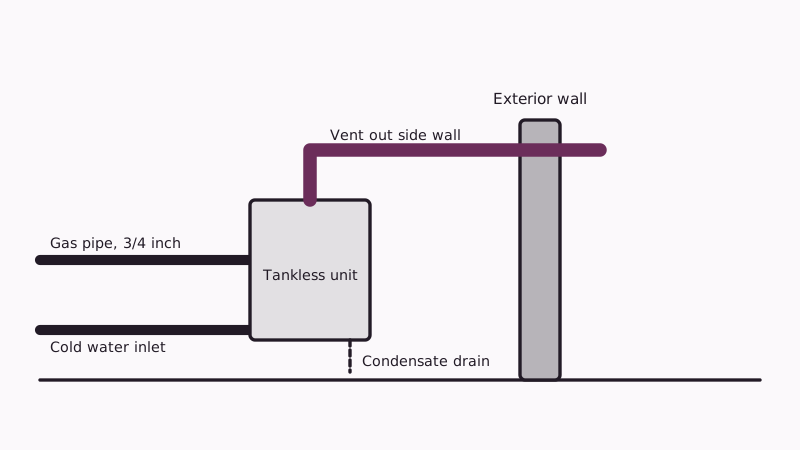
- Gas. Both the meter and the house line may need study, and gas piping is work that state law reserves for a contractor. More on that at gas line work.
- Vent. Out a side wall, through the roof or up an old chimney. Condensing models also produce acidic condensate that needs a drain.
- Water. A three quarter or one inch inlet is usual.
- Electric. Most electric models want 208 or 240 volts and the amperage noted earlier.
The deeper walkthroughs are a gas unit going in and an electric unit going in.
Does North Orange County water change the verdict?
Yes, it nudges things. Anaheim's own hardness page lists about 18 grains per gallon, a level the industry calls very hard, and the Energy Department guideline notes that some makers ask for a softener beyond 8 to 14 grains. Scale clogs the narrow heat exchanger in a tankless unit, whereas a tank mostly collects it at the bottom.
So a tankless purchase here should come with a descaling routine. Makers suggest flushing anywhere from two times a year to every third year, depending on model and use. Softener basics are on softener installation and scale control. Fullerton, Orange and Brea run their own water systems, so read your own supplier's annual report.
Are mini tank and propane heaters worth a look?
A mini tank holds only a few gallons and feeds one sink or a distant bathroom, never a full house. Propane versions behave like natural gas ones but need a tank and delivery, so they matter mostly where no gas main runs. Across most of North Orange County, natural gas is already at the curb.
Point-of-use electric tanks hold only a few gallons. They cut the wait at one far tap and still cannot stand in for the main heater.
What rules apply when a heater is replaced in California?
Section 19211 of the state Health and Safety Code orders every water heater secured against shaking, with bracing, anchors or straps at least to the plumbing code's standard. A swap also needs a permit pulled with your city's Building Division, and the work sits with a contractor.
California's contractor board draws its licensing threshold at $1,000 of labor plus materials, and permit-triggering work is covered regardless; a heater swap meets both conditions. Find out whose name goes on the permit and who schedules the inspector. Details sit in the permit explainer, and heater lifespan helps with timing.
Common questions
Does tankless ever leave me with lukewarm showers?
It never empties the way a cylinder does, since it heats water in motion. It can fall behind when several fixtures open together, because output tops out near 2 to 5 gpm, and a shower plus laundry plus dishes can ask for more. A larger model, or a second unit, covers big families.
How long does installing either kind take?
Trading one cylinder for another often fits inside half a day. Tankless tends to eat the better part of a day, sometimes two, since gas pipe, venting, a condensate drain or new wiring can ride along. Ask for an hours estimate, and for the length of the shutoff, in the paperwork.
What if a repair would do instead of a new unit?
A repair is often sensible while the base of the tank stays dry and the heater is younger than about 6 to 8. Rheem's guidance flips toward replacement once repair costs pass half of what a new unit would run. See repair pricing and causes of no hot water.
What belongs on the estimate before work begins?
Look for the permit fee, earthquake straps, a new relief valve plus its drain pipe, an expansion tank if the system needs one, and hauling the old tank away. On a tankless job, add gas pipe size, the vent route and a flushing schedule. Start on the quote page, where each of these gets spelled out.
More services are listed on the plumber guide for Anaheim.
Sources
- US Department of Energy, tankless or demand-type water heaters
- US Department of Energy, Measure Guideline: Transitioning to a Tankless Water Heater
- City of Anaheim Water Hardness page
- California Health and Safety Code section 19211, water heater strapping
- California Contractors State License Board, hire a contractor
- Rheem, water heater lifespan, repair versus replace
- Angi national installed water heater costs, updated July 2026
Last updated