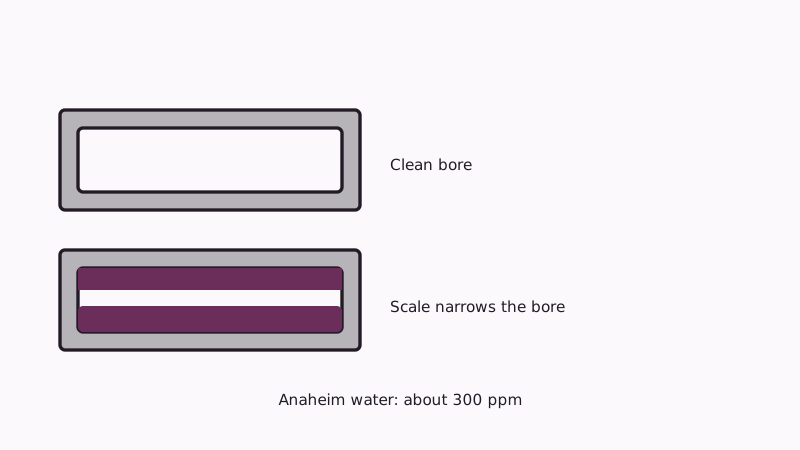
In plain terms from Citrus Belt Plumbing: scale forms when hard water is heated or evaporates and leaves calcium and magnesium behind as a crust. The only ways to stop it are to remove those minerals before the water is heated, or to manage where and how they collect. A water softener installed by a plumber is the usual fix for whole-house protection, and this page covers the rest.
What causes hard water scale?
Dissolved calcium and magnesium are to blame, and USGS defines hardness as precisely those two. Once water is heated or evaporates, the minerals drop out of solution and set into a white or gray crust on elements, faucets, showerheads and glassware.
Heat accelerates the process, so heaters, kettles and dishwashers are the first to scale. USGS says hardness poses no health concern but is a nuisance: it leaves residue, eats soap, and wears out anything that heats water.
How is hard water measured: grains per gallon, ppm or mg/L?
Labs report hardness in milligrams per liter, which equals parts per million, and utilities often quote grains per gallon too. On the USGS scale, 0 to 60 is soft, up to 120 moderately hard, up to 180 hard, and anything higher very hard. One grain per gallon works out to roughly 17.1 mg/L.
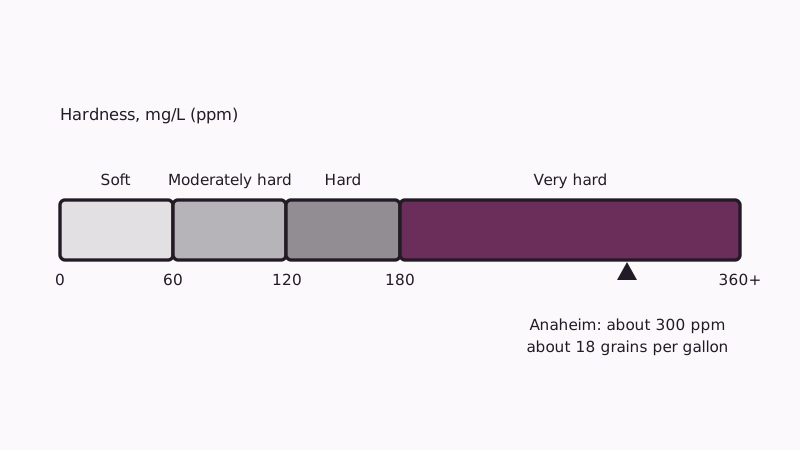
That conversion is why Anaheim's "about 300 ppm" and "about 18 grains per gallon" are the same figure stated two ways. Both land in the very hard band. A rating scale for hardness is only about minerals, so it is a different thing from the pH scale, which measures acidity and does not tell you how much scale to expect.
| Class | mg/L (ppm) as calcium carbonate | Roughly in grains per gallon |
|---|---|---|
| Soft | 0 to 60 | 0 to 3.5 |
| Moderately hard | 61 to 120 | 3.6 to 7 |
| Hard | 121 to 180 | 7 to 10.5 |
| Very hard | Above 180 | Above 10.5 |
The grains column is my own conversion of the USGS figures using 17.1 mg/L for each grain.
How hard is Anaheim's water?
Very hard. Anaheim's utility lists roughly 300 ppm, around 18 grains per gallon, and the 2025 Water Quality Report ranges from about 8 to 25 grains depending on how groundwater and imported supply are blended. Fullerton, Orange and Brea each have their own suppliers and reports.
Because the figure moves, a one-time reading is a snapshot. The best check is your own supplier's latest water quality report or a home test strip. Anaheim Hills is part of the city, so it is served by the same utility, though pressure and plumbing differ. Our Anaheim Hills plumber page has more on local conditions.
Where does scale do the most damage?
The water heater suffers most. Rheem says scale can reduce heating efficiency by up to 30 percent, drives elements to overheat and burn out, and quickens corrosion in the tank. Tankless units scale up in their narrow channels. After that come aerators, showerheads, dishwashers, ice makers and washers.
Pipes can narrow over time too, which shows up as falling water pressure. Older homes in Anaheim, Fullerton and Orange with galvanized pipe are the most exposed, because rough interior walls give scale a place to cling. If a faucet runs weakly after years of use, scale may be one cause. See low water pressure.
What actually prevents hard water scale?
The dependable cure is a salt-based softener, which strips calcium and magnesium before water reaches the heater. Lesser measures treat the symptoms: flush the heater, renew its anode rod, keep the thermostat at 120 to 130 degrees Fahrenheit, and descale fixtures with vinegar cleaners.
Rheem names a softener the best long-term answer for a water heater and recommends flushing tanks annually, or twice yearly in hard water, plus the 120 to 130 degree setting to slow scale. Step-by-step material is in heater lifespan and care and installing a softener.
Do anti-scale conditioners work?
Anti-scale conditioners, often marketed as salt-free softeners, leave calcium and magnesium in the water. The pitch is that scale forms differently and clings less. Evidence is mixed, so treat them as a partial measure; only a conventional softener removes hardness.
Ask a seller for independent test data before buying, and set the price beside a softener's. A conditioner will not deliver the slick soft-water feel. For pricing of either, see softener installation cost, and the quote form begins a local visit.
Common questions
How long does it take scale to build up?
It depends on hardness, usage and temperature. In very hard water, a visible film on a showerhead can appear within weeks, while a water heater floor accumulates sediment over months and years. Heating elements may coat in a year or two. A regular flush and a softener slow every one of those timelines.
What should I ask before buying a water softener?
Ask for a water hardness test of your supply, the grain capacity of the unit, the salt use and regeneration schedule, drain and electrical requirements, and the written installed price. Ask about any local rule on discharge from softeners. A good installer sizes the unit from your numbers.
Can I remove scale myself?
Yes, on fixtures. Immerse showerheads and aerators in white vinegar, wipe tile with a mild descaler, and keep up the heater flush. Acid does not belong on pipes or inside gas heaters. Inside a tankless unit, follow the maker's descaling procedure or let a plumber handle it.
Does a water softener make water unsafe to drink?
Softened water has added sodium, in small amounts. That matters for people on strict sodium limits, who should ask a doctor. Many homeowners install a separate unsoftened tap for drinking. A plumber can set that up when the softener is fitted.
Does hard water harm my health?
USGS says it does not; it is a nuisance. The harm falls on appliances, fixtures and pipes. For any other quality worry, open the annual water quality report from your supplier, which lists every contaminant measured, and ask a doctor about specific health questions.
Sources
Last updated