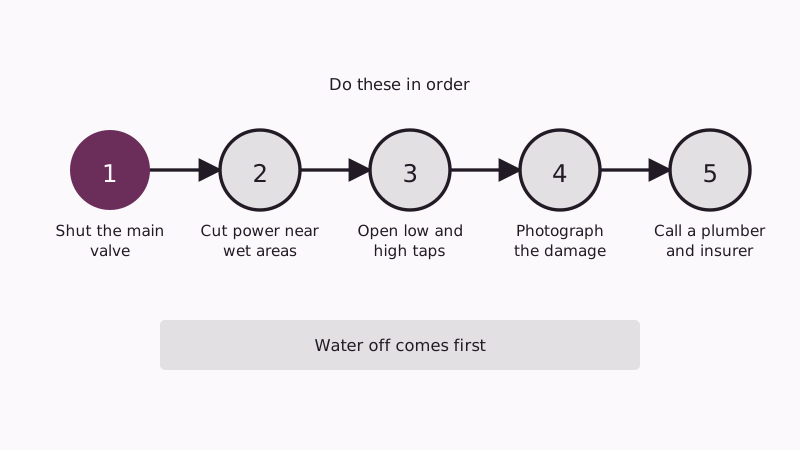
Household water pressure turns a split pipe into a small fountain, and a fountain indoors becomes a wet ceiling surprisingly fast. Everything on this page assumes one rule: stop the supply before doing anything else. After that come electrical safety, drying out, the repair and the claim. The callout service has its own write-up under burst pipe plumbers; to ask for someone, use the quote form.
Where is the main valve and how is it closed?
The house main usually hides on the street-facing side beside the front spigot, or else in the meter box set into the parkway. Wheel handles close clockwise. Lever handles close by turning a quarter turn until the lever sits across the pipe. Close it all the way, then check that a nearby tap runs dry.
A frozen or stubborn valve is a real possibility in older homes, because these valves are exercised rarely. Leaning on a cheater bar can snap the stem. At the meter, the utility's own valve is the fallback, and the water department can help when neither will turn.
The city looks after the pipe under the street; for most properties the owner holds the pipe running meter to house. So a split in the yard between those two points is yours to fix, even if it never goes near a wall.
What about electricity and the water heater?
Water and electricity meeting is the injury risk, not the flood. If the splash zone includes outlets, a power strip or the panel, cut those circuits from a dry position. A panel that is itself wet is a reason to leave it alone and phone 911 or the power company. After the main is shut, shut down the water heater as well, so it cannot run on an empty tank.
Then drain the system. Crack one tap at the lowest point and one at the highest so trapped water escapes, and one flush of each toilet clears the tanks. Pull rugs, lift anything absorbent, and start moving water with towels or a wet vac.
A ceiling that bulges and sags with trapped water can be relieved by puncturing it above a bucket. It is better to control that release than to wait for the whole panel to give way.
Burst or seep: how can I tell?
Sound and speed tell you. A burst hisses, sprays or pours, and leaves a soaked patch in minutes. A seep hides, staining a wall over weeks, raising the bill or making the meter creep. Still unsure? There is a longer list of clues in how to tell a pipe has burst.
The meter settles it. With every fixture closed, watch the dial and the little low-flow triangle; movement means escape. The EPA's figure for leaks is more than 9,300 gallons a year in the average household, and a split supply pipe can burn through a comparable amount within a couple of days.
If the wall and ceiling are dry yet the dial keeps turning, the leak is probably behind finishes or beneath a slab, and a leak detection visit is the next move.
Why would a pipe burst here, with so few frosts?
Anaheim winters rarely freeze, so ice is a long shot. More probable culprits: steel or copper thinned by decades of corrosion, a pressure regulator that has stopped working so the house takes full street pressure, repeated water hammer, and soil movement or roots outdoors. The state plumbing code caps household static pressure, and the regulator is what holds a home beneath that cap.
Mineral-heavy water speeds up the aging. Plenty of Anaheim, Fullerton and Orange homes still carry the original supply lines, and bursts there commonly follow years of small weeps and brown water.
Further reading on avoiding the problem sits in burst pipe prevention and in the explanation of why pipes split.
How is a split pipe actually repaired?
After finding the break, the plumber removes the failed stretch and splices in new pipe, with solder or mechanical fittings depending on material. Brittle old pipe can justify replacing a longer run, since a short patch tends to shift the next failure a few feet along. Everything is pressure-tested before walls close.
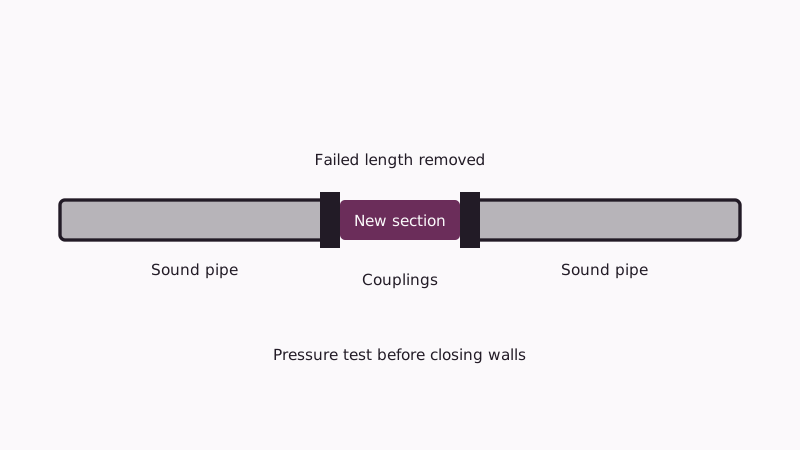
A typical visit, in sequence:
- Confirm the supply is off and locate the break.
- Open the finish only as far as the repair requires.
- Remove the damaged length and fit the replacement.
- Bring pressure back slowly and watch every joint.
- Mention any other pipe that looks tired.
Drywall, paint and flooring belong to other trades, and the plumber seldom dries the structure out. A mitigation company handles that, and your insurer may have preferred names. More about the repair side is in leaking pipe repair and in the emergency burst pipe service.
How does a homeowner insurance claim for a burst pipe work?
Most home policies pay for sudden, accidental water damage up to their limits, and many refuse slow leaks blamed on wear or neglect. Take photos and video before cleaning, hold onto ruined items for the adjuster, and keep receipts for emergency spending. Wording differs between policies, so the insurer's answer outranks any general summary.
Coverage for the failed pipe itself also varies: some policies pay for the resulting damage only. The page on burst pipe insurance cover lays out typical patterns, and ask the insurer which documents they need from the plumber, such as an invoice stating the cause.
Common questions
Which phone call comes first?
Close the valve, then phone a plumber, then your insurer on the same day. Nobody needs permission to limit the damage, and most policies expect reasonable steps. Keep the photos and the plumber's paperwork together. We work weekdays between 9am and 5pm, so on a weekend the water utility is the number to ring if the valve stays open.
Is the house usable with the main off?
Generally, once electrical hazards are cleared. There will be no flushing, so plan for that. Leave the supply off until the break is mended or capped, and when it returns, open a few faucets first to let trapped air escape. Wet insulation inside walls holds moisture, so get it checked.
What is the time frame for the fix?
A split within easy reach may be mended in a single visit. When the break sits in a wall or ceiling, or the plan becomes a repipe, the job grows, since opening, mending and testing all take time. Drying the structure runs on for days under a different crew. An estimate is possible once the damage is exposed.
Does one burst mean more are coming?
In an older home, often yes, since neighboring pipe shares the same age and water. A burst on new work may just be a faulty joint. Request a frank assessment of the rest of the piping and on the pressure regulator, and check pressure at an outdoor spigot with a gauge.
For the wider picture, start with Citrus Belt Plumbing plumber.
Sources
Last updated