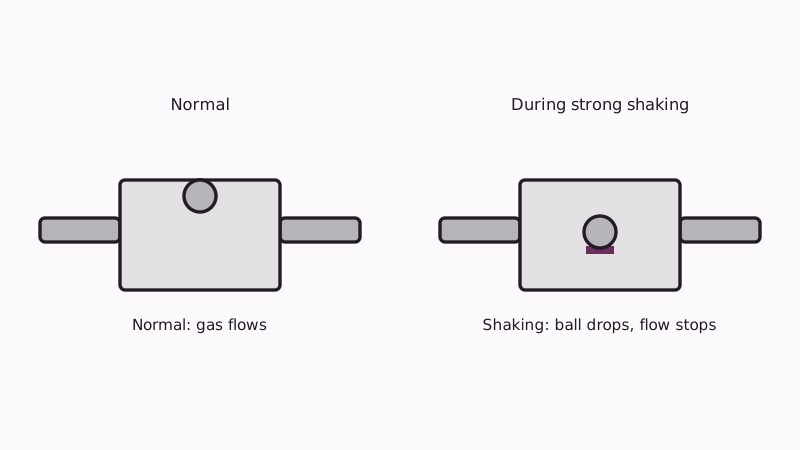
Think of it as a tripwire on the pipe feeding your appliances: strong shaking closes it, and gas stops flowing into a damaged house. A qualified professional fits it beyond the meter under a permit. The meter carries a shutoff of its own, which belongs to the gas company. See our gas line plumbing page for the wider picture.
How does an earthquake valve protect the house?
After a strong quake it keeps new gas out of the building. A weighted ball or similar sensor inside moves once shaking crosses a set level, falls into an opening and blocks the flow. The point is to reduce fire risk from a snapped appliance connector or cracked pipe once the shaking ends.
It will not make a damaged gas system safe, and it does not detect a slow leak. Some valve types instead close when flow suddenly jumps, which would suggest a broken pipe. Others only react to motion. Valves also come in pressure classes, and the plumber picks one that matches your gas line size and pressure.
A gas smell after a quake gets the same answer with or without a valve. Everyone leaves. Use a safe distance, then dial 1-800-427-2200 for SoCalGas. For any threat to life, 911.
Where on the gas line does the valve go?
It goes on the customer side of the meter, in the pipe that runs toward the building, and normally sits outdoors close to the meter. Nothing goes inside the utility's meter vault or onto the meter, which belongs to SoCalGas.
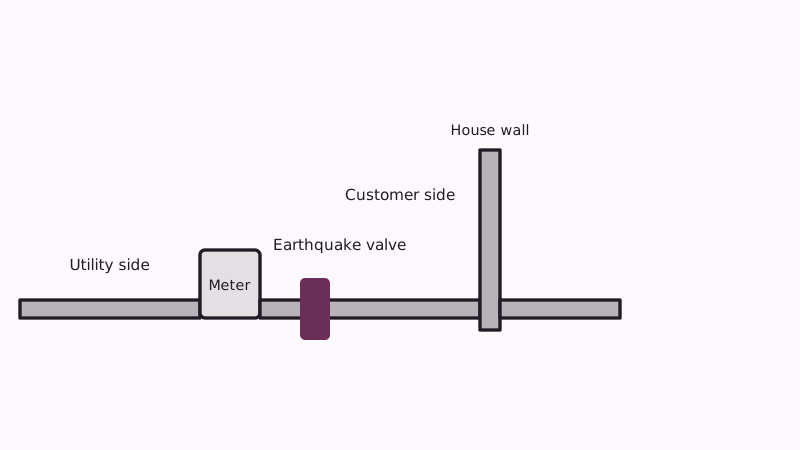
SoCalGas leaves earthquake valves to others and keeps customer-owned equipment off its own facilities. A valve fitted by an installer on the house line is allowed, though local building offices may set rules about size and brand. The valve also has to be level and mounted in the orientation it was approved for.
Keep the area around the meter clear. A meter box in a low spot with poor drainage, or a pipe buried under shrubs and a planter, makes inspection and later service harder.
Who is allowed to fit one in Anaheim?
Pick a contractor with a state license. Your city's Building Division issues the permit, which the job requires. The valve model itself needs state approval, which an inspector checks. This is not a homeowner project, since regulated gas piping with a poor joint can leak.
Rules about when a valve is mandatory are set city by city, usually at new construction, major permitted work or sale of a home. Online sources disagree about Anaheim, so call the Building Division of your city before you assume. Every city, Fullerton and Orange and Brea included, has its own office. Your insurer may also ask for one.
For the wider gas job, a gas line install usually covers the valve and the pipe work together. Prices depend on pipe size and site conditions, so see gas line cost rather than trusting a number we cannot source.
What should you do after the valve trips?
Resist reopening it straight away. After strong shaking, leave it shut, look for damage and sniff for gas, and if anything seems off, leave and call SoCalGas. A plumber or the utility should do the reset, and appliances need a safety check and relit pilots before they run.
Many models list a homeowner reset in the maker's instructions. SoCalGas still favors a professional or its own crew, and warns that restoring service after a big disaster can take days or weeks. The utility bills for resets and relights when the valve closed over something other than a quake.
Steps and limits are in the guide to resetting an earthquake gas shut-off valve. The meter has its own service valve, which is not yours to touch: state regulation reserves it for SoCalGas and its authorized contractors.
How is an excess flow valve different?
The earthquake type reacts to shaking on your own line. An excess flow valve lives underground on the service pipe between the street main and the meter, and chokes the flow if that pipe is severed. SoCalGas, not a plumber, fits it, and it does not answer earthquake damage by itself.
For an excess flow valve, SoCalGas names a range starting around $2,500 and running to $5,000 or more, set by the property. It cannot stand in for a valve on the house line.
Think of them as layers. The utility-side valve guards the street connection. The house-line valve guards the building after strong shaking. Neither fixes a leaking appliance connector, which is why an inspection of the flexible connectors on your furnace, dryer, stove and water heater is worth doing. See also the water heater gas valve page.
What else should you check on older gas lines?
Older homes in Anaheim, Fullerton and Orange can have worn flexible connectors, corroded black iron pipe near the meter or a gas line fitted before today's code. An inspection can find them. Postwar tract homes in Buena Park and La Habra often still have the original lines. A plumber can add a valve or replace parts in one visit.
Water heaters are also a quake risk: strap them, as California requires, so they cannot tip and tear a gas connector. For pipe sizes and flex line rules, see our flexible gas line guide.
Common questions
Is a seismic valve compulsory in Anaheim?
Not by a rule we could confirm. Online contractor pages disagree, and requirements are decided by each city and often tie to sales, new work or permits. Call your city's Building Division before assuming, and ask your insurer if they want one. We do not state a rule we cannot source.
May a homeowner fit the valve?
Not legally in practice. Gas piping is regulated, so a qualified contractor does it with a permit in place. Disturbing a gas line yourself risks a leak or a failed inspection. Turning the valve back on after it trips is a separate matter, and manufacturer instructions cover that.
Can SoCalGas install an earthquake valve for me?
No. SoCalGas states that it does not install them. The valve goes on the house line beyond the meter and is fitted by a qualified professional. If the job needs the gas off at the meter, that single step belongs to SoCalGas. If the install needs the gas off at the meter, SoCalGas handles that step.
How do I know the valve has closed?
If gas appliances stop working after a quake and the pilot lights are out, the valve may have tripped, or the utility may have shut off service. Do not guess and do not relight anything. Smell for gas, leave if you notice any, and call SoCalGas.
Does a seismic valve protect against every gas leak?
No. It reacts to strong shaking or a surge in flow. A small leak in an appliance connector or a hairline crack may not trip it. If you ever smell gas, treat it as an emergency, whether or not a valve is installed.
Every service and price guide is on Citrus Belt Plumbing.
Sources
Last updated