Start with a dairy. La Palma was incorporated in 1955 as Dairyland, one of three dairy cities in the area, and when the herds moved east in 1965 the city took its present name. It covers 1.80 square miles, the smallest in Orange County, and almost everything in it went up in a hurry. Surrounding cities each have a page by way of where we work; the full list of jobs is on the home page.
What happens to plumbing in a city built almost overnight?
It ages together. La Palma's population grew from 622 in 1960 to 9,687 in 1970, so most houses and condos were built within roughly one stretch of years, and their original pipes, fixtures and valves are reaching the end of their lives around the same time. One failure on a street often predicts the next.
The 2020 census counted 5,270 housing units, 97.9 percent occupied, with about 68 percent owner-occupied and 32 percent rented. Typical calls: a faucet cartridge or shutoff valve that will not seal, a toilet that runs, a heater whose tank is past its prime, supply lines that weep at a joint. A tub that keeps dripping is a faucet repair, but a drip behind a wall is not. Old fixtures are cheap to replace one at a time, though many owners prefer to schedule several together to save on visits. A whole-house repipe makes sense only when leaks keep recurring.
What changes when your home shares walls with others?
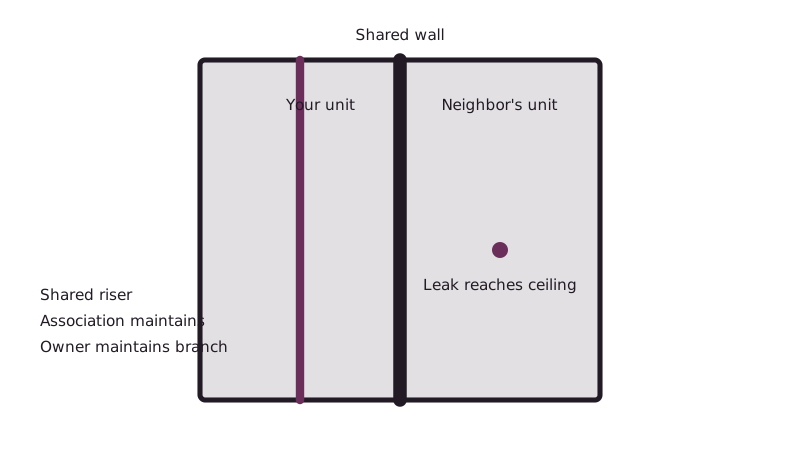
A lot. A share of La Palma's homes are condos or townhomes, where one unit's leak becomes the neighbor's wet ceiling. A brown patch on a ceiling can originate upstairs, in a shared wall, or in a building-wide line. The ceiling water leak page covers how to trace it.
Who pays depends on your association's governing documents, which usually say which pipes the owner maintains and which belong to the association. Read yours before calling anyone, then pass what it says to the plumber. Find your unit's shutoff valve now, not during a leak, and ask the manager whether a building-wide valve exists. Noise is another shared-wall issue: a banging pipe, covered in the water hammer guide, can carry to the next unit.
How hard is La Palma's water?
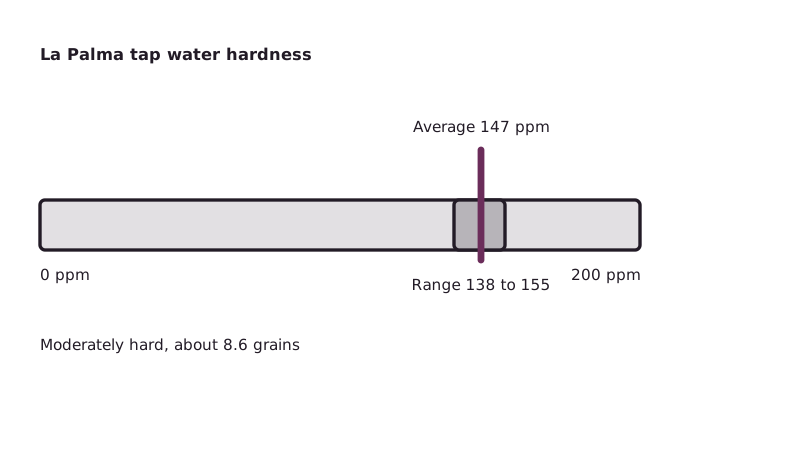
Moderately hard, and softer than most of the surrounding area. The city's 2025 report, which covers 2024 testing, shows total hardness averaging 147 ppm, within a range of 138 to 155, a little under 9 grains of hardness per gallon (8.6). No regulation covers hardness, since it is a natural mineral content.
La Palma runs its own water supply under the Community Development and Public Works Department. According to the report, the supply is groundwater managed by OCWD, topped up with treated surface water that MWD brings in from Northern California and the Colorado River. Some addresses could be served by a different utility, so confirm on your bill. At 8.6 grains, scale builds in a tank water heater more slowly than in harder districts, but it still builds. A yearly drain-down is worth the twenty minutes. For anything on the heater itself, see water heater repair.
Which approvals apply in La Palma?
The Building & Safety Division, part of Community Development, at 7822 Walker Street (714-690-3340). Its permit application carries a plumbing section that includes gas piping, and the city also issues permits through an online portal. A water heater replacement is a permitted job.
As for who is allowed to do the job, the state licensing board (CSLB) explained in its AB 2622 notice that the under-$1,000 exemption from the license rule covers only jobs needing no permit and no employees. In a condo, add a second layer: your association may require notice, insurance details or approved hours before any contractor touches a shared line. Ask the manager early. Our water heater permit walk-through lists the usual steps.
What should a La Palma plumbing visit cost?
No La Palma price list exists, so use regional guides as a ruler. In 2026 published guides, a tank water heater installed ran roughly $900 to $2,600, with labor at $100 to $200 an hour. Smaller condo jobs often finish near the lower end.
In practice, what moves a La Palma quote: a heater wedged into a closet or garage corner, shutoffs that have seized after sixty years, a shared-line job that needs the association's approval, and the permit. Price detail sits on the water heater cost page and in what plumbers charge. The published numbers disagree by hundreds of dollars, so only the written quote counts.
How do I schedule someone in La Palma?
Send your address through the quote form, noting whether the home is a condo or a house and what is going wrong. A local plumber arrives, examines the problem and itemizes the work before it starts. The phone is answered weekdays, nine until five. We have no walk-in counter. Water coming through a ceiling? Close the unit's shutoff, then read the emergency plumber page.
Common questions
Whose job is a leak that begins in the neighboring unit?
It depends on where it starts. A leak from a neighbor's fixture is usually that owner's to fix, while one inside a shared wall or building line is often the association's responsibility, per its governing documents. Report it in writing, shut off your own unit's water if it is flooding, and take dated photos in case an insurer asks.
Is tap water here hard or soft?
Moderately hard. The city's report for 2024 testing averages 147 ppm, equal to 8.6 grains in each gallon, and its samples stayed between 138 and 155 ppm. Scale is a slower problem than in harder parts of North Orange County, but tank heaters still benefit from a yearly flush.
Does La Palma want a permit for a replacement tank?
Yes. La Palma treats a replacement heater as permitted work, handled by its Building & Safety Division, with an inspection to follow. A contractor files the application. In a condo, also check with your association first, since many require notice or approval before work begins. Keep the permit and inspection record with the unit's papers.
Sources
Last updated