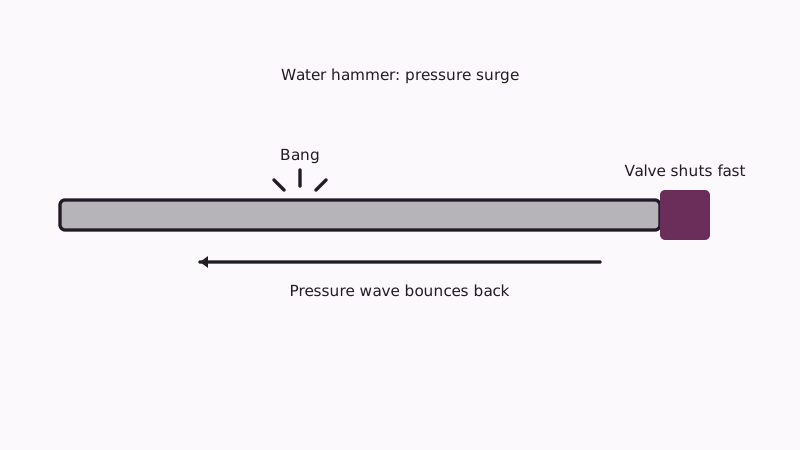
That thud behind the wall when the washer fills and then stops is a pressure wave. Moving water carries weight and speed; when a valve halts it almost instantly, the energy rebounds along the pipe and the pipe knocks against its straps or the studs. Citrus Belt Plumbing arranges visits around Anaheim, CA for this noise, and the checks below follow the order a tradesperson would use.
What is the water hammer sound, and what causes it?
Water hammer is a loud bang, thud or shudder in the pipes when flow is cut off fast. It is caused by a quick-closing valve, such as the one in a washing machine or dishwasher, a toilet fill valve, or a single-lever faucet, stopping moving water at once. High pressure, loose pipes or a dead air cushion make it worse.
Wikipedia, which also lists the effect as hydraulic shock, names fast-closing appliance and fixture valves as a trigger. Inside a wall, a loose pipe slaps the framing and magnifies a mild surge into a knock. If only one fixture makes the noise, start with that fixture's valve.
How do I tell which valve or fixture is causing it?
Work through the fixtures one at a time, closing each quickly: bathroom sink, shower, toilet, kitchen tap, washer, dishwasher. A fixture that bangs on every try is your lead. If everything bangs, look at whole-house pressure or something near the main.
Note when it happens. A bang when the dishwasher fills, a rattle after a toilet flushes, or a thump when the irrigation timer shuts off tells you where to look. Also listen for a hiss or buzz, which may be a failing valve rather than true water hammer. Write down which fixtures bang before you call, since it saves time on the visit.
Could high water pressure be the cause?
Yes, and test it before anything else. Faster water hits a closing valve harder. California Plumbing Code 608.2 calls for a pressure regulator when static pressure tops 80 psi, and a worn-out regulator may be passing street pressure straight through. A hose-bib gauge gives the reading.
With the gauge above 80 psi, cushioning devices cannot cure the noise, since pressure is the cause. The steps for checking and setting a regulator are in adjusting a pressure regulator. When the regulator cannot keep its setting, replacement pricing is on the regulator cost page.
Can I fix water hammer by draining the pipes?
Sometimes, where the house has air chambers: short vertical stubs behind fixtures that trap a pocket of air. They gradually fill with water and stop cushioning. Draining the plumbing lets air return. It costs nothing and takes minutes, but the knock may come back after a few months.
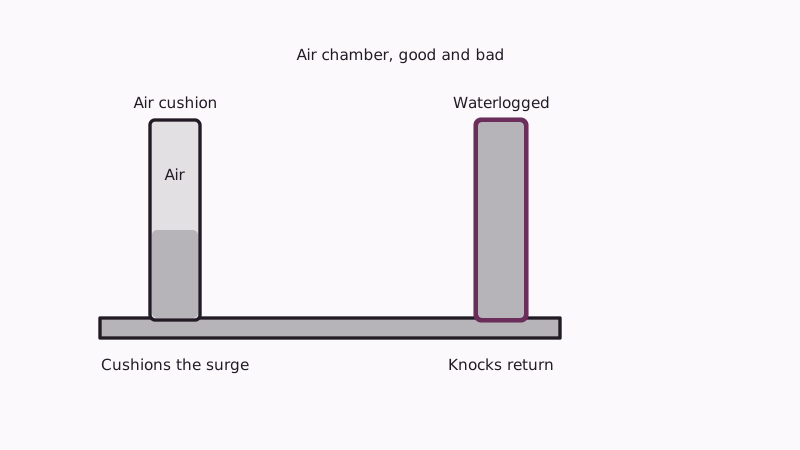
Turn the main off, open the top-floor tap and then the lowest to empty the pipes, close them, and reopen the main slowly. Knocking that returns means the chamber has waterlogged again, and a sealed arrestor is the permanent answer. A tradesperson can say whether your fixtures even have chambers.
What is a water hammer arrestor, and where does it go?
Think of an arrestor as a compact sealed cylinder that behaves like a shock absorber: a piston or bladder sits against a charged air cushion. It threads onto the supply near the valve that slams, for instance at a washer or dishwasher, and soaks up the spike so the pipe stays quiet.
A sealed unit cannot waterlog the way an open air chamber does. Washer arrestors that thread between hose and wall valve are an easy do-it-yourself swap. Ones inside a wall need a plumber and may mean opening drywall, so access drives the price.
Do loose pipes and old plumbing make it worse?
Yes. Pipes that are not strapped firmly can slap against framing and amplify a small surge into a bang. A plumber can add pipe clips or foam insulation where the pipe touches wood. In older homes in Anaheim, Fullerton and Orange, supply lines have often been added and moved over decades, so clamps and straps are sometimes missing.
Mineral scale plays a part too. The City reports Anaheim water at about 18 grains per gallon, a very hard figure, and deposits can stiffen valve seats and stops. See preventing scale. For hillside lots such as Anaheim Hills, pressure can differ from lot to lot, one more reason to gauge the line.
Which signs mean the banging needs a professional?
Bring someone in when the bang is violent, when it persists after you check pressure and drain the chambers, when you see leaks, stains or new joint movement, or when arrestors are needed inside a wall. Repeated hammering can loosen fittings and eventually cause a leak, so persistent noise is worth a visit.
Note which fixtures bang, at what moment, and what the gauge showed. That lets a plumber test the regulator, fit arrestors and secure loose runs. The quote form starts a local visit. Related guides on noises and pressure are collected in the advice hub.
Common questions
Does the banging do any harm?
Rarely right away, yet it signals strain on the system. Repeated pressure spikes can loosen joints, wear valves and eventually cause leaks, especially with high pressure or older pipes. If you hear it regularly, fix the cause rather than live with it, and check for dampness around the noisy fixture.
What makes pipes knock when a tap is closed?
Flowing water stops abruptly at the valve and its energy has only one direction left: back along the pipe, where it shakes anything loose. Loose mounting, high pressure or a waterlogged air chamber amplifies it. Closing a manual faucet more slowly softens the hit.
What does fixing water hammer cost?
The cause decides. Draining the lines is free, a washer arrestor is a small purchase, and regulator replacement or in-wall arrestors cost more. Expect a price once the cause is confirmed. Labor billing is explained in hourly rates for plumbers.
Can a water softener or heater cause water hammer?
Indirectly. A water heater adds thermal expansion, which can raise pressure in a closed system and make hammer worse, and a closed system with a regulator needs an expansion tank. A softener does not cause hammer on its own, but any valve in the system can slam if pressure is high.
Does water hammer mean I have a leak?
Not on its own. Repeated hammering can work a fitting loose, though, so look for damp patches, stains and a climbing water bill. If you think there is a leak, repairing a leaking water pipe shows how to confirm it.
Sources
Last updated