La Habra takes its name from a gap in the Puente Hills, and the city still sits right against them, about 299 feet above sea level. Roughly a century of building shows in its pipes. Add water that is among the stiffest in the county and you get a predictable set of calls. Here is how those play out street by street. Neighbouring cities each get a page of their own via where we work; browse the whole job list from the home page.
Why is tap water in La Habra so rough on heaters and fixtures?
La Habra water is very hard. The city's report on 2020 testing shows 270 parts per million for local groundwater and 265 for imported water, with a spread from 210 to 420, which is about 12 to 25 grains per gallon. Minerals precipitate as chalky crust on faucet aerators, inside kettles and around the heating surfaces of a water heater, and they build up faster as the water warms.
Three sources feed the city's mains, per its own report: treated imports from the MWD (Colorado River plus northern California supply), San Gabriel Valley groundwater bought through Cal Domestic, and three municipal wells drawing on the La Habra basin. Because the blend moves through the year, the number at your tap moves too. Hardness is unregulated and not a health risk. It is a wear problem. A yearly drain-down of the tank and a peek at the anode rod buy time; the scale prevention guide sets out the routine, and softener pricing is there if you want the minerals out entirely. Look up the latest city report, since the figures here are from the 2020 edition.
What is hiding inside a La Habra house built before 1960?
Often a mix of generations. The 2020 census counted 20,801 housing units here, with 56.8 percent of occupied homes lived in by their owners. Avocados made La Habra famous (it was Southern California's largest avocado center by 1928), and the single-story houses that replaced the groves mostly arrived over the next three decades.
A house that old can still run on galvanized steel water pipe, which rusts inwards until a shower dribbles. Later remodels usually switched to copper. Under the slab or the front yard, drains were commonly cast iron or clay, where roots and settled joints cause repeat blockages. Those are patterns, not promises. A pressure gauge and a drain camera settle the question. If you suspect galvanized, read about replacing it, and for a budget picture see replumbing an older home.
Streets running up toward the hills raise a separate question. Static pressure climbs as you go downhill, so the lowest lots on a slope see the highest readings. A tired regulator passes every pound along to the fixtures and the heater.
Is the 2014 earthquake still relevant to pipes here?
Yes, a little. A magnitude 5.1 earthquake hit on March 28, 2014 with its epicenter about a kilometer east of town. The USGS logged intensity VII near La Habra and Brea, and the damage included broken water mains. The fault system beneath this part of the county is the Puente Hills thrust.
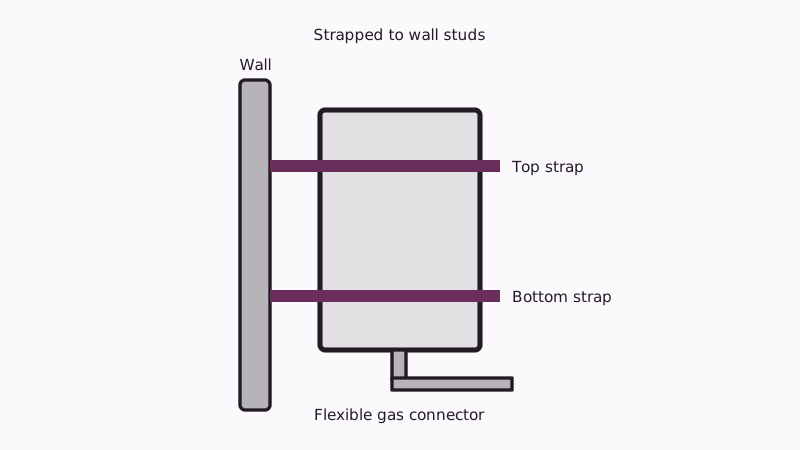
Typical aftermath jobs: a water heater that walked off its straps, a flex connector that cracked, a damp ceiling. Smell gas? Walk everyone outside, and only then dial the SoCalGas leak number, 1-800-427-2200, with a safe distance between you and the house. If anyone feels unwell or a hiss is audible, make it 911 as well. Leave light switches alone. An automatic shutoff valve on the gas meter limits the risk, and how those valves work is explained on its own page. Gas pipe jobs are reserved for a contractor holding a California license.
What will La Habra plumbing work cost?
Plan on published ranges, then expect a written number from the visit. Angi's July 2026 national figures show an installed gas tank at $700 to $2,700 and an electric tank at $600 to $3,500, an Orange County guide gives $100 to $200 an hour for labor, and Angi's repipe guide says most homeowners spend $1,500 to $15,000.
In La Habra the swing factors are a cramped garage or hall closet, pre-war pipe that resists a clean cut, and permit and inspection time. The guides disagree by hundreds of dollars, so read them as a spread. Each has a page: what plumbers charge, water heater replacement and repiping.
What does the city require before a water heater goes in?
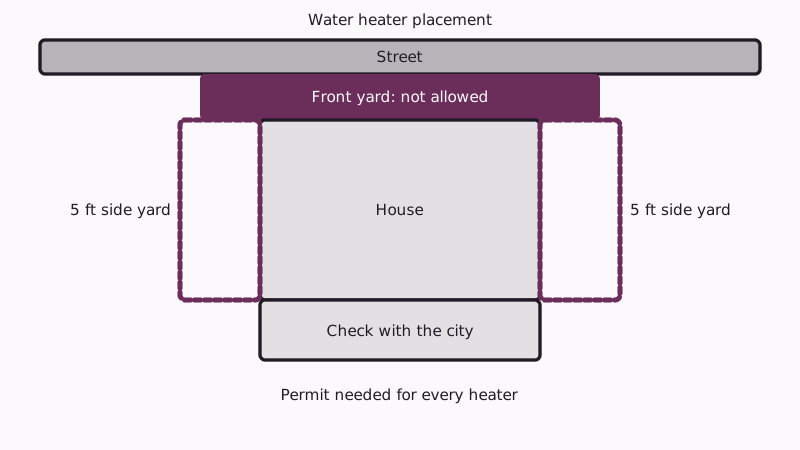
A plumbing permit, every time. La Habra's Building and Safety Division (110 East La Habra Boulevard, 562-383-4116) lists one for each replacement or new installation, and its handout bars tanks from the front yard and the five-foot side yard. It also calls for a relief valve piped to a drain.
Fiscal year 2025-26 fees in the city schedule: $28 to issue the permit plus $10 for the heater, with inspections billed by the hour. Confirm before budgeting, since fee tables get revised. The water heater permit guide lays out the sequence.
Who may do the job matters too. The Contractors State License Board explained in its AB 2622 notice that a person without a contractor license can accept work worth $1,000 or less only when no employee and no building permit is involved. Swapping a heater requires a permit, so it falls outside that exception. Look up any contractor by name or number at cslb.ca.gov.
What is the next step if I need someone in La Habra?
Use the quote form, adding the address and one line about what is wrong. A local plumber drives out, inspects the fault, and writes up the price before starting. Phones are open weekdays, nine to five. No storefront exists, so there is nothing to drive to.
Useful to mention: what you see or hear, where the main shutoff is, whether the heater runs on gas or electric, and a photo of its data label. If water is pouring out, turn off the main first and keep the emergency page open.
Common questions
What does a La Habra plumber visit usually run?
An Orange County guide quotes labor at $100 to $200 hourly, often with a minimum visit charge. A faucet or toilet fix can end below $400, while a water heater or repipe lands in the thousands. The quote you receive after the visit is the figure that counts.
Does swapping a La Habra water heater need city approval?
Yes. La Habra wants a plumbing permit, issued by its Building and Safety Division, for every replacement and new installation, followed by an inspection. Your contractor usually files it. Ask for the permit number on the quote and keep the final sign-off, because someone may ask to see it when you sell.
How hard is the water here?
Very. The city's report on 2020 samples shows 270 ppm for groundwater and 265 for imported water, ranging from 210 to 420, so about 12 to 25 grains per gallon. Scale gathers in heaters and on fixtures. Annual tank flushes slow it, and a softener removes most of it.
Sources
- La Habra, California
- City of La Habra, Annual Drinking Water Quality Report (2020 data)
- City of La Habra Building and Safety Division, Water Heater Requirements
- City of La Habra, Plumbing Permit Fees FY 2025-2026
- 2014 La Habra earthquake
- Angi national installed water heater costs, updated July 2026
- Angi, cost to repipe a house, 2026
- Suburban Plumbing OC, Orange County plumber rates
- California Contractors State License Board, AB 2622 press release
Last updated