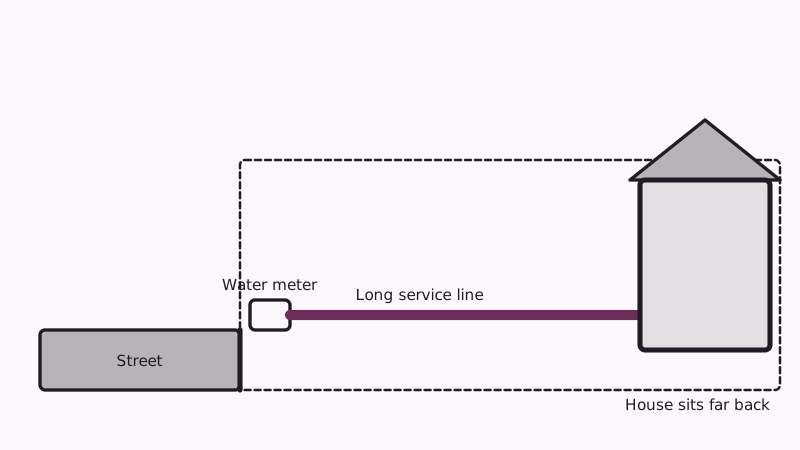
Villa Park covers only about 2.1 square miles, yet it is the least crowded corner of the county: 2,020 homes, most on lots that average about half an acre, and 94.5 percent of occupied homes lived in by their owners. Wherever a house sits that far back from the street, the pipes follow. Visits are arranged citywide. Surrounding towns have pages via where we work, and every service is on the home page.
Why do big lots change the plumbing?
Because every extra yard is another yard of pipe. Houses on half-acre lots tend to sit well back from the street, so the water line from the meter and the sewer line to the main run long, and a pool, a tennis court or a guest house adds branches. Each fitting along the way is a place to leak or get blocked.
Three results follow. Long hot-water runs mean standing at the tap waiting, a gripe some owners fix with a return loop. A buried leak can run unseen for weeks under a lawn, so a bill that jumps with no change in habits deserves a look. The high water bill guide walks through how to isolate it, and leak detection pricing shows what finding one costs. Irrigation lines, pool equipment and outdoor spigots all tie into the same supply, so they belong in the inspection too. Villa Park has no public parks, and many yards carry pools or courts of their own.
How hard is Serrano Water District water?
Very hard. The district's report on 2024 testing shows total hardness of 343 ppm in the water delivered to customers, with samples between 333 and 365, which converts to roughly 20 grains per gallon. Minerals at that level leave a visible film and scale quickly, and the figure is well above what many homeowners expect from a tap.
Serrano Water District supplies all of Villa Park and a small part of the city of Orange. Per its report, the supply blends local surface water with imported Metropolitan Water District water stored in Santiago Reservoir (Irvine Lake), plus groundwater pumped from the aquifer under OCWD's care. The district dates to 1876 and holds a half share of the lake. In kitchens and baths, 20 grains shows up as a white film on glass, crust on faucets and a heater that scales up. Softeners are common for that reason: see softener installation cost, and see softeners and water bills before buying.
What kind of houses are these?
Mostly single-family houses, and many are large. The city incorporated in 1962 on the old orange country that gave the area its character, with winding streets, few sidewalks and parkways planted with trees. Citrus was the main crop here for about 60 years before homes replaced the groves.
Plumbing age depends on the lot. Houses from the earliest postwar subdivisions may still carry their first galvanized or copper supply, while renovated and rebuilt properties are likely to have newer pipe. With so many large homes, whole-house repiping is a bigger job than average, and prices climb with square footage; see repipe cost for ranges. On any of them, a worn pressure regulator can let the supply push harder than the fixtures were built for. Replacing a regulator is a short job next to the leaks it can head off.
What approvals does Villa Park ask for?
The city's own "When Is a Permit Required" sheet names water heater and water softener change-outs, re-pipes, and any adding, replacing or moving of plumbing lines or fixtures. Building permits are processed through the city's Building, Public Works and Engineering department, and there is an online application portal.
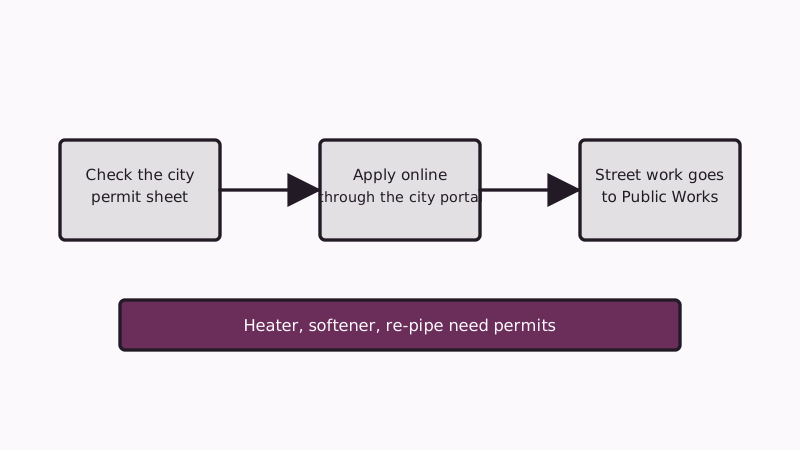
Work that touches the street is separate. The same sheet lists sewer lateral connections, excavations and encroachments under Public Works, and the city's code requires an excavation permit before anyone digs in or under a public street. That matters on a sewer repair that reaches the curb. The Contractors State License Board's AB 2622 notice limits the under-$1,000 exemption from the license rule to jobs needing no permit and no employees, so permitted work needs a contractor the state has issued a license to. Phone the city first, since fees and forms get revised. The permit walk-through explains the order of steps for a heater.
What do jobs cost in Villa Park?
Published guides vary widely, so the written quote sets the figure here. Large houses push toward the high end of the repipe range because there is more pipe to replace. Ask for the repipe price in writing, and ask what length of pipe it assumes.
Once a visit is done, the written quote replaces any guide. Higher Villa Park bills have identifiable causes: long runs, hard-to-reach equipment, and extra items such as pool or irrigation connections. Typical plumber charges are set out on their own page.
What is the booking process for Villa Park?
Tell us what is wrong in the quote form, adding the address and a few photos. A visit follows, and the plumber who inspects the property puts a price on paper before beginning. Phones are staffed weekdays from nine to five. Water gushing from a pipe? Turn the meter valve off at once, then use the emergency page.
Common questions
Is a permit mandatory when a Villa Park tank is swapped?
Yes. The city's permit sheet lists water heater and softener change-outs, and an online application is available through the city's portal. Your contractor files it. Ask the city about the current fee, and ask your contractor to keep the inspection sign-off with your house records.
Why is my Villa Park water so hard?
The district's supply blends local surface water, imported Metropolitan water held in Santiago Reservoir and groundwater from the Orange County aquifer. Its 2024 report shows hardness around 343 ppm, about 20 grains per gallon. Minerals dissolve naturally on the way, so scale is normal; a softener or regular tank flushing deals with it.
What should a Villa Park plumbing job set me back?
Plumbers commonly charge hourly labor, and a service fee frequently sits on top. Small repairs may total a few hundred dollars. Water heaters and repipes run into the thousands, and large lots mean longer pipe. Only a written quote from a visit sets your actual figure.
Sources
Last updated