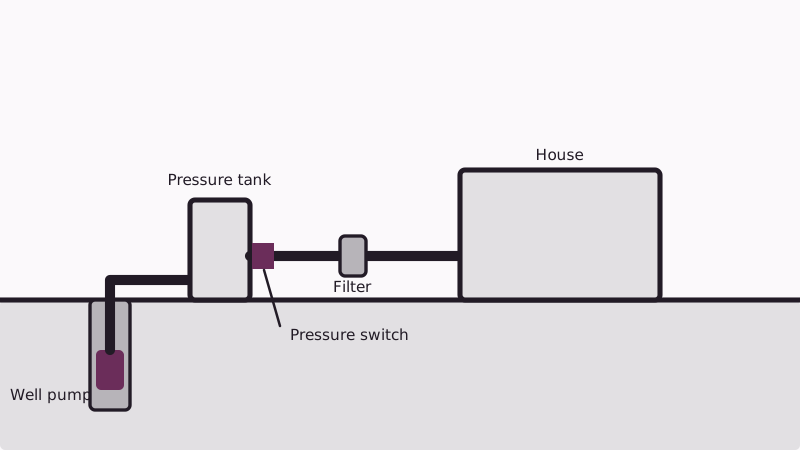
Most houses in Anaheim, Fullerton and Orange take water from a city or district, so this page matters only if you have a private well, or a shared one run by a small system or HOA. A well adds four parts that a city line does not have: the pump, the pressure switch, the pressure tank and the filter. Weak flow usually means one of them. If your house is on city water, the page on hiring a plumber for weak pressure is the better start.
Why is the pressure low in my well system?
The usual suspects are a pressure tank that has lost its air charge, a pressure switch set too low or failing, a clogged sediment filter, a worn pump that cannot reach its shutoff pressure, or a leak that lets pressure bleed away. Watch the gauge near the tank while a tap runs. Where the needle sits, and how fast it moves, points toward the culprit.
Read it like this:
- Needle swings quickly and the pump clicks on and off. Suspect a lost air charge or a waterlogged tank.
- Pump runs without stopping and the needle never reaches the upper setting. A worn pump, a leak, or a clogged line or filter.
- Needle sits steady but low. Suspect a low switch setting or worn contacts.
- Needle is normal at the tank but weak at the tap. Look for a clogged filter, partly closed valve or scaled pipe between the tank and the house.
What pressure should the tank and switch be set to?
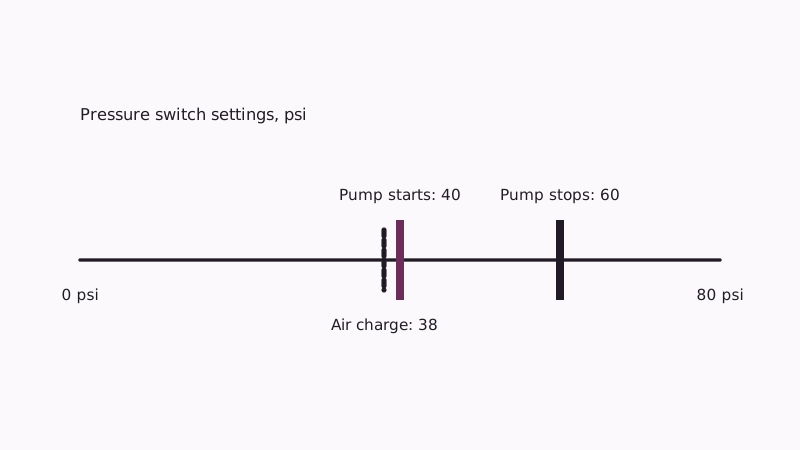
Many residential well systems use a 40/60 switch, which starts the pump at 40 psi and stops it at 60. Another common pairing is 30/50. The tank's air charge should sit about 2 psi below the pump's start pressure, measured with the tank drained and the pump off. For a 40/60 switch that means 38 psi, and for a 30/50 switch 28 psi.
Safety matters here. Turn the pump's power off at the breaker before touching the switch or tank. A pressure tank holds stored energy, so open a tap to drain it before checking the air valve with a tire gauge. If you raise the switch setting, check that the pump can actually reach the new shutoff pressure and re-set the tank's air charge to match. Switch contacts and wiring carry household voltage, so many owners leave the switch itself to a pro.
Setting a switch higher is not a fix for a failing pump. It may only make the pump run longer and fail sooner.
What if the yard hose is strong but the indoor taps are weak?
When the hose bib runs strong and the indoor taps are weak, the problem sits in the indoor branches, not the supply. Likely causes are clogged aerators or showerheads, a partly closed fixture stop, a scaled or corroded section of pipe, a clogged water heater inlet or an indoor filter or softener that needs service. The outdoor line is short and open, so it hides these restrictions.
Work through it in order. Find out whether one fixture or all of them are affected, then compare hot against cold. If only the hot side is feeble, look first at the water heater and the valves around it. Weakness everywhere indoors with a healthy yard hose sends you to the whole-house filter cartridge and any treatment equipment. Inside older Anaheim and Orange homes, galvanized supply lines can scale up over decades and choke flow; the long-term fix there is galvanized pipe replacement.
Why would my pressure drop suddenly, or in cold weather?
A sudden drop points to something that failed: a pump that quit, a tripped breaker, a burst or leaking pipe, a clogged filter or a pressure switch that failed. Check the breaker first, then the tank gauge. Cold weather rarely matters in our mild climate, but exposed pipes and pump houses can freeze in a hard snap.
If the pump runs but little water reaches the tap, a supply-side leak may be sending water into the soil. Listen for a pump that cycles while every fixture is closed; that points to a leak. EPA's average-home leak figure is more than 9,300 gallons yearly, and on a well each of those gallons also costs pump hours.
Elevation adds load. A hillside lot in Anaheim Hills or Yorba Linda sitting well above the pump needs more lift, because about 1 psi is lost per 2.3 feet of rise, which is why a weakening pump shows up there first. If a shared system serves your street, the HOA or water company runs the pump and tank, and an area-wide drop should be reported to them.
Who do I call for low water pressure in my house?
On city or district water, start with the utility and ask whether street pressure is normal. With a private well, call a plumber or a well service contractor. A plumber can fix a regulator, filter, tank or house piping; a pump or well problem may need a company that works on wells.
Before calling, gather useful details: the pressure gauge reading, whether the pump runs, the age of the tank and pump, and any recent work. Not sure which supply you have? Look for a pressure tank and wellhead on the property, or read the water bill. City-water homes will find more in the step-by-step on fixing weak pressure.
Is a pressure regulator part of a well system?
Not usually. A regulator trims high pressure from a municipal main, which is not a well problem. Well systems rely on the pump, switch and tank to hold a pressure range. Where a well house does carry one, it guards against the pump overshooting. Under the state plumbing code a regulator is expected whenever static pressure would pass 80 psi, so a well system set higher than that needs one.
Further reading: finding the regulator and swapping a regulator.
Common questions
Can a clogged filter cause low pressure on a well?
Yes. Sediment filters collect sand and scale, and as they fill they restrict flow, so pressure at the taps falls while the tank gauge looks normal. Replace the cartridge on the maker's schedule, sooner if the water is cloudy. If the new cartridge clogs quickly, the well may be pumping sediment, which needs a well specialist.
Should I replace the pressure tank or the pump?
Not before testing. A short-cycling pump with a normal air charge points to the switch or a leak. A waterlogged tank may be recharged or replaced. Pumps that run constantly and never reach shutoff may be worn. A plumber or well contractor can check amps, pressure and flow before recommending which part to replace.
Is it safe to adjust the pressure switch myself?
Only with the power off, and only if you are comfortable with electrical work. The switch carries household voltage, and a wrong setting can overwork the pump. Many owners limit themselves to checking the gauge and tank air charge and call a pro for the switch. Never open the cover while the breaker is on.
What does a repair cost?
Prices swing with the part and the site, and we have no dependable local figure, so get a written quote. A filter cartridge or a tank air recharge is minor; a new pressure tank, switch or pump costs considerably more. The visiting plumber can write up a price before any work begins.
This guide is one of many on plumber anaheim.
Sources
- Published well pressure tank and pressure switch settings guides (40/60 switch, precharge 2 psi below cut-in), checked November 2026
- California Plumbing Code section 608.2, excessive water pressure
- US EPA WaterSense, Fix a Leak Week
Last updated