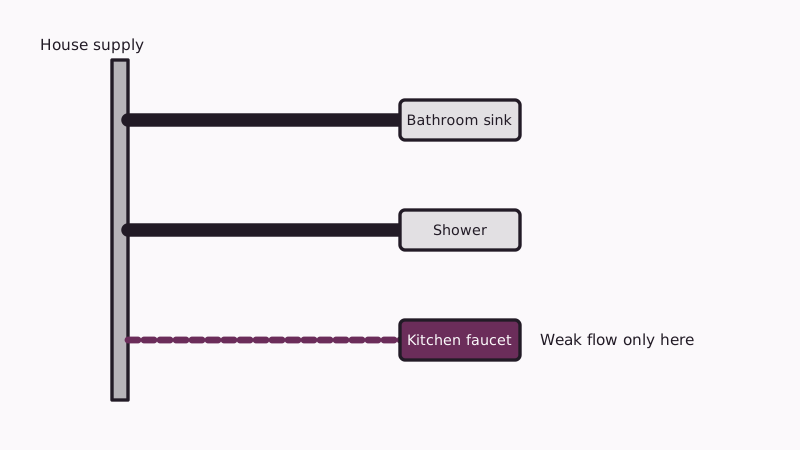
Open the bathroom faucet, then the shower. Both strong? Then the weakness is confined to the kitchen, and the cause sits somewhere between the spout and the two small valves in the cabinet below. Both weak? Skip ahead to the house-wide section. The same cabinet holds the valves, hoses and drain you will be reaching for, so this guide sits next to garbage disposal and sink work.
| What you notice | Probable cause | First move |
|---|---|---|
| Weak stream, spray splits sideways | Clogged aerator | Unscrew and clean it |
| Weak after plumbing work or a utility shutoff | Debris in aerator or cartridge | Clean the aerator, flush the lines |
| Hot side weak, cold fine | Heater valve, hot angle stop or hot line | Check the hot stop first |
| Cold side weak, hot fine | Cold angle stop or supply line | Check the cold stop |
| Weak only in spray mode | Diverter or sprayer hose | Test spout mode, inspect hose |
| Everything weak, all fixtures | Regulator, main valve or pipe | Screw a gauge onto the outside spigot |
How can I tell a faucet problem from a house-wide problem?
Compare fixtures. A strong bathroom sink and shower with a weak kitchen faucet put the fault at the kitchen faucet or its two supply lines. Weak flow everywhere puts the trouble upstream: the main valve, the regulator or the pipe itself. Fixture comparison takes a minute and saves a lot of guessing.
Add a split test. Weak hot only: look at the water heater outlet and the hot angle stop. Weak cold only: the cold angle stop and line. If it changed suddenly after pipe work or a utility shutoff, loosened debris is the prime suspect. For the house-wide version, see low water pressure causes, and for the shower side, low shower pressure.
Why is the aerator the first thing to clean?
Because it clogs more than anything else. The aerator is the little mesh screen at the spout tip, and it catches grit and mineral flakes. Twist it off, rinse it, then soak it in plain vinegar until the scale softens. Ten minutes and no cost, and it cures a large share of weak-faucet complaints.
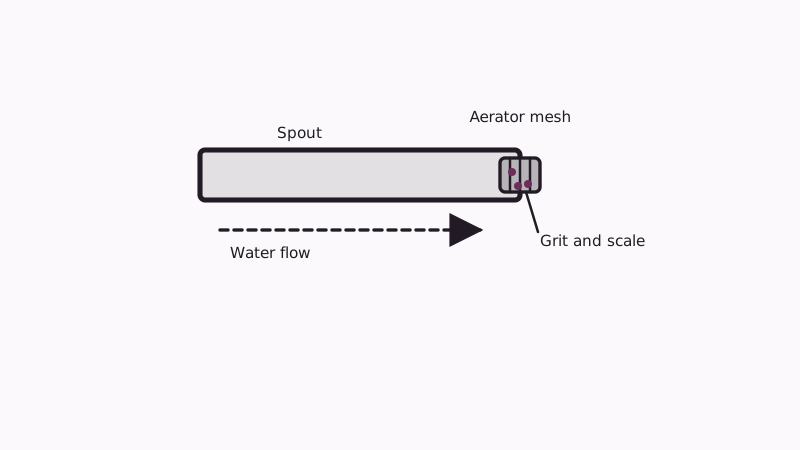
Hard water is a regular culprit in North Orange County, where groundwater and imported supplies leave mineral scale behind. To confirm, run the tap with the aerator removed and the basin empty. If the stream strengthens, the screen was the culprit. Reinstall it clean, or buy a replacement for a few dollars, matching the thread type.
Strength is also a matter of design. Design plays a part too. California's Title 20 caps kitchen faucets and their aerators at 1.8 gallons a minute when tested at 60 psi, though some models can briefly boost to 2.2 for filling pots. A new faucet can therefore seem gentler than the old one, and that is normal. Keep the correct aerator for your faucet and keep it clean.
Is one of the two small valves in the cabinet partly closed?
Often not, especially after a repair. Each faucet has two angle stops, hot and cold, and a handle that was left partway shut will throttle flow. Turn each one counterclockwise until it stops, using a gentle hand. If a stop is stiff, crusty or weeping, plan to replace it, not force it.
Then trace each braided supply line from the stop to the faucet. A hard kink where the hose was bent to clear the disposal or a drain can pinch flow. Straighten it, or replace it, since new lines are inexpensive. If a hose is old, change both together. For the leak side of this cabinet, the leak guide for under the sink draws the line on DIY.
Could the cartridge, sprayer or diverter be failing?
Yes. A single-handle faucet has a cartridge that wears and collects grit, and a pull-out sprayer has a diverter and hose of its own. Shut the water, take out the cartridge, rinse it and check the seals. If the weakness appears only when you use the spray head, the diverter or the hose quick-connect is the likelier source.
Test spout mode and spray mode separately, and look at the hose for kinks. Parts come from the faucet maker, and most cartridges are a short job. Two related guides explain the work: a leaky kitchen faucet and stopping a leaky faucet. If you decide to replace the whole faucet, faucet installation cost lists the typical price.
Does a filter, softener or disposal change the flow?
A drinking-water filter or reverse-osmosis tap restricts flow by design, and a spent filter restricts it more, so check the cartridge date. A softener with a fouled resin bed, or a bypass left half open, can cut pressure at several fixtures. A garbage disposal rarely affects the faucet, though new installation can disturb the lines.
If weakness appears only at a filtered tap, change the filter on schedule. If your main kitchen faucet went weak after a new filter or softener went in, bypass it and test again. Hard water can foul filters earlier than the label suggests.
What does a house-wide pressure problem look like?
Every fixture runs weak, or the pressure rises and falls through the day. A reading on a hose bib gauge shows where you stand. Normal indoor pressure runs 45 to 65 psi according to Padre Dam, a Southern California water district quoting the plumbing code, and a regulator is required above 80 psi.
Causes range from a failing regulator or a half-closed main valve to rusting galvanized pipe or a leak you have not found. Galvanized lines in pre-1970 Anaheim and Fullerton houses narrow as rust builds, so the weakness creeps. Hillside homes in Anaheim Hills may see swings with elevation. Measuring pressure and flow at the main lets a plumber narrow it down.
Which signs mean a plumber should take over?
The signs: the faucet is clean and the stops are open but flow stays weak, valves or lines are corroded, every fixture is weak, or the cabinet is wet. A faucet swap is a fair weekend job. Permitted work and larger pipe changes require a contractor license, which the state board requires from the $1,000 mark.
Expect a plumber's visit to include a pressure test at the main, a look at the regulator, and a check of valves and lines, and a written price before work. Rust-colored water alongside weak flow points to corroded pipe, where a repipe may come up.
Common questions
Why is only the kitchen faucet weak when the bathroom is fine?
Something local is choking the flow. Candidates are the aerator, a stop valve not turned all the way, a pinched hose, a tired cartridge or a blocked sprayer line. Work from the spout downward: aerator, valves, hoses, cartridge. Most cases end at the first step.
Does vinegar clean an aerator?
It does. White vinegar dissolves mineral scale, so an hour or two of soaking loosens it, and a small brush clears the rest. For stubborn buildup, soak longer or replace the aerator. Rinse it well before screwing it back on.
Why did pressure drop after a plumber worked on the pipes?
Pipe work can stir up sediment that lodges in aerators and cartridges, and valves sometimes stay partly closed. Look at the aerator first, then the stops and the main valve. If the weakness persists, let the plumber who did the work know.
Can a new faucet really flow less than my old one?
Yes. A new model must stay under California's cap of 1.8 gallons a minute, measured at 60 psi, while the federal standard is 2.2. A newer model can feel gentler even when nothing is wrong. A flow far below that means a blockage.
Need a plumber to look? Start at the quote page, or visit the Citrus Belt Plumbing home page.
Sources
Last updated