Replacing a disposal looks like a one-hour swap until the dishwasher enters the picture. Under a typical kitchen sink, the disposal's side port, a short rubber hose, an air gap on the countertop and the trap all have to line up, and each one is a place for a leak or a drain that never empties. For the main service page on this work, see garbage disposal installation. The notes below cover the hookup itself and the points where bringing in a plumber is wiser. To book, use the quote form.
How does a dishwasher connect to a garbage disposal?
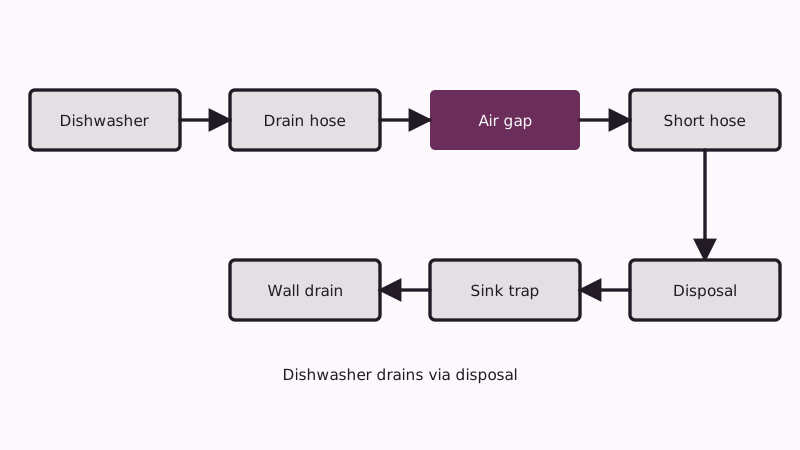
The dishwasher drain hose runs up to an air gap fitting on the sink deck, and a second short hose runs from the air gap down to the nipple on the side of the disposal. The disposal's outlet then feeds the sink trap. Water leaving the dishwasher passes through the disposal housing on its way to the drain.
In sequence, the path is: dishwasher pump, drain hose, air gap, second hose, disposal inlet, disposal discharge, trap, wall drain. If your sink has no air gap, there may be a high loop instead, but see the code note further down, because California is stricter than some states.
Each hose connects with a screw clamp. Worm-drive clamps should be snug, not crushing. A kinked or sagging hose is the usual reason a dishwasher leaves a pool of water in the bottom.
What is the knockout plug, and why does the dishwasher not drain without removing it?
Fresh-from-the-box disposals have a thin plastic disc sealing the dishwasher inlet port. It has to be knocked out before the hose is connected. If it stays in, the dishwasher has nowhere to send water, and you get a dishwasher full of gray water. Removing it later, once the disposal is mounted, is the usual way to find out.
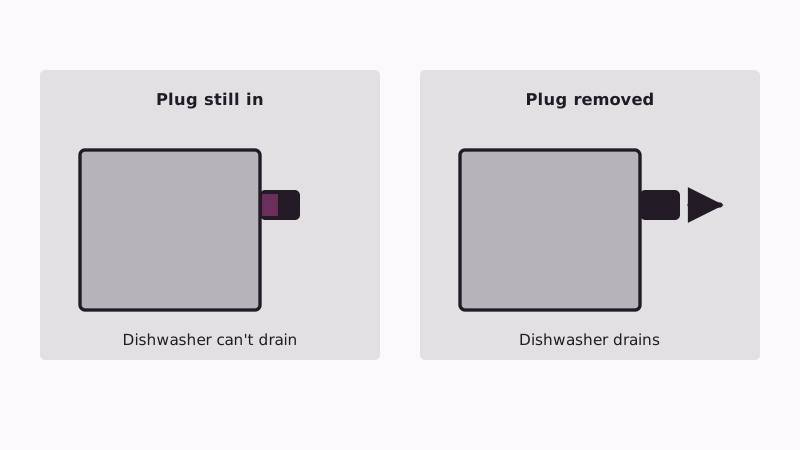
Take the plug out before mounting the unit. Set a screwdriver against it from inside the grinding chamber and tap with a hammer until it pops, then fish the piece out. A plug fragment left rattling inside the chamber causes noise, can block the port and has been blamed for repeated air gap overflow.
If the unit is already mounted, reach in with the power off, using a long screwdriver and a magnet or tongs, and never put your hand inside.
Does California require an air gap?
Sources that summarize California's plumbing code say a dishwasher draining into a disposal or sink must go through an approved air gap fitting, with its flood-level mark at or above the sink's flood level, and that inspectors may not accept a high loop alone. The code text itself has not been checked here, so confirm with your city.
The air gap is the small chrome or plastic cap on the back of the sink deck, next to the faucet. Its job is to leave a physical gap between the dishwasher and the drain, so sink water can never be siphoned back into the machine. Other states accept a high loop of hose secured near the underside of the counter.
Check with the Building Division before you rely on a high loop, particularly if the work is permitted or you are selling. For a replacement that is not moving anything, matching what is already there is the least likely to raise questions.
How is the disposal itself installed?
You remove the old unit and the flange, set the new sink flange in plumber's putty, tighten the mounting ring under the sink, hang the disposal on its mount and turn it to lock. Then connect the discharge elbow to the trap, attach the dishwasher hose and wire the power. Wipe away the excess putty and test.
Power is the part to take seriously. A disposal runs on household current, either with a cord to a switched outlet or hardwired through a junction box. Kill the circuit at the panel, verify it is dead, and follow the maker's wiring diagram. Moving or adding a circuit is electrical work that may need a permit.
Heavy units need a secure mount. Check that the unit hangs level, the discharge points to the trap and no rubber gasket is pinched. A dry run with water before closing the cabinet catches most leaks.
What fixtures and faucets does this touch?
Kitchen sink fixtures all share one cabinet: the faucet supply lines, the shutoff valves, the sink strainer, the disposal and the dishwasher supply. Working under the sink on one often reveals the condition of the others. A cracked supply line or a corroded shutoff belongs on the same job list.
If the faucet is old, hard water scale may be clogging the aerator, and a sink faucet that drips can be repaired separately; see stopping a dripping faucet. Costs for fixture work are listed in faucet installation cost.
A disposal that jams or hums is not always a failed motor. Before buying a new unit, work through clearing a blocked kitchen sink, because a blocked line often causes the symptoms.
When should a plumber do the hookup?
Hand it over when the sink drain is old, corroded or oddly laid out, when you need a new air gap hole drilled in a stone countertop, when a new circuit or outlet is required, or when you are unsure of the code. A pro also leak-tests the result and sets the trap arm at the right slope.
Drilling an air gap hole in granite or quartz is a specialist job, because the wrong bit can crack the stone. That alone is a reason many homeowners book the work. Older homes in Anaheim, Fullerton and Orange often have steel or cast iron under-sink drains that crumble when disturbed, which turns a disposal swap into a pipe repair.
Hard water leaves scale at the strainer and in the trap, and fresh parts help only so much. For other plumbing work, the Citrus Belt home page lists the service, and what a plumber costs gives a feel for pricing.
Common questions
Do I have to remove the dishwasher knockout plug?
Yes, if you are connecting the dishwasher to the disposal. The plug blocks the inlet port, and nothing will drain until it is removed. If you are not using the port, leave it in place. Remove it before mounting if you can, and make sure no piece is left in the chamber.
Why does water come out of the air gap?
Usually because the drain downstream is slow or blocked. The disposal may be clogged, the knockout plug left in, or a hose pinched. Water that cannot leave the sink pushes back up and spills from the air gap. Clear the disposal and the trap first, and check the hose from the air gap to the disposal.
Can the dishwasher drain into the sink trap instead?
Many layouts connect the dishwasher to the disposal, while others use a tailpiece fitting on the sink drain with no disposal. Without a disposal, the same air gap question applies. The layout depends on your plumbing and the code, so check with the city or a plumber before changing it.
How long does installation take?
Someone experienced can usually finish a like-for-like swap in a couple of hours; a first attempt takes longer. Add time for a new air gap, a fresh outlet or tired drain pipe, and have any quote spell out those extras.
Sources
- Published installation guidance on dishwasher air gaps, knockout plugs and disposal hookups, checked November 2026
- Manufacturer installation manuals for food waste disposers (dishwasher inlet, mounting assembly, power connection)
Last updated