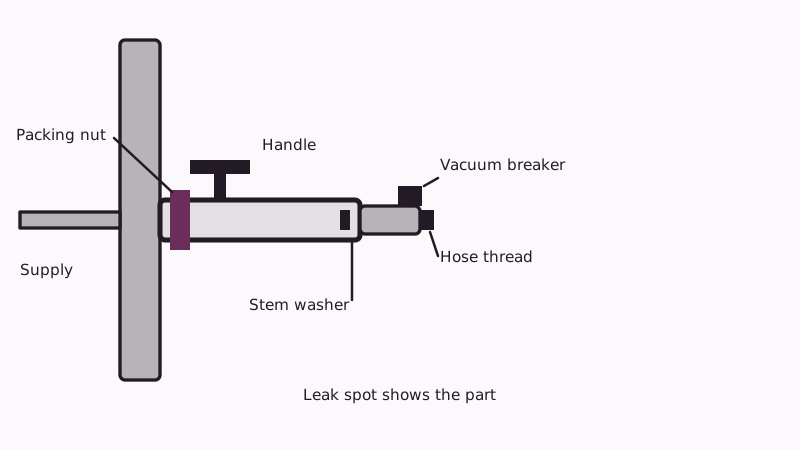
Hose bibs, the outdoor spigots on the side of a house, leak in three typical places, and the spot where the drip appears narrows the repair. Water at the handle means worn packing. A drip from the spout with the valve closed means a tired washer. Water spraying from a small cap near the spout means the vacuum breaker. Indoor fixtures work much the same way; for those, start at our garbage disposal and sink fixture pages.
Which part is failing on my spigot?
Let the wet spot name the part. Water from behind the handle while the faucet is on points to the packing nut or packing. A steady drip from the spout with the faucet closed points to the stem washer or a worn seat. Spray from the little cap by the spout means the vacuum breaker. A drip where the hose screws on is usually the hose washer.
| Where the water shows | Likely cause | Usual fix |
|---|---|---|
| Behind the handle, valve open | Packing nut or packing | Tighten a quarter turn, or repack |
| Spout drips, valve closed | Stem washer or seat | New washer, or replace the bib |
| Small cap near the spout | Vacuum breaker | Replace the breaker or its diaphragm |
| Where the hose screws on | Hose washer | Drop in a new rubber washer |
| Inside the wall or crawl space | Frost-free stem or soldered joint | Replace the bib; call a plumber |
Before you buy parts, check the cheapest suspect. A split or missing washer inside the hose coupling causes fine spray or drips right at the connection, and the faucet itself is fine.
How do I stop water seeping out around the handle?
Leave the water on and snug the packing nut, the hex nut right behind the handle, with a wrench, no more than a quarter turn clockwise. Cranking it harder stiffens the handle and can scar the stem. If that does not work, shut the water off, back the nut off and wrap two or three turns of graphite packing string around the stem beneath it.
Some bibs use a rubber packing washer or O-ring in place of string. In that case, slide off the old black rubber piece and fit the new one from a repair kit. For this repair, close the indoor shutoff, let the line drain through the open spigot, and rebuild in reverse order. Restore water slowly and watch the handle area for beads of moisture.
What if it drips from the spout while closed?
Close the main or the bib's own indoor valve, open the spigot to empty it, then remove the handle screw, handle and packing nut and unscrew the stem. A rubber washer sits on the stem's end, held by a brass screw. Fit a new one of identical size and shape; carrying the old washer to the store makes matching easy.
Tighten that screw gently, because brass threads strip. A spigot that still drips after a fresh washer usually has a scored seat inside the body, and no simple repair fixes that; swapping the whole bib is cleaner. Local water adds to the trouble: the city utility reports hardness near 18 grains per gallon, and mineral crust on the seat keeps new washers from sealing.
What if water sprays from the cap near the spout?
That cap covers the vacuum breaker, a backflow safety device that stops dirty hose water from siphoning into the house supply. When it spits, unscrew the cap, take out the cartridge or diaphragm and look for cracks or scale. Replace a worn one with a new part, and never leave the spigot without it.
On some older models the plastic cover unthreads and the float inside is replaced from a kit. Test your repair with a hose attached and the nozzle closed, which loads the faucet with full house pressure against a dead end and shows up a marginal breaker. If your spigot has no breaker at all, a screw-on one is available for most threaded spouts and is worth adding, since a hose left in a bucket or pool can pull water backward.
How is a frost-free faucet different?
Its long stem, roughly 8 to 18 inches, puts the valve seat inside the warm wall so the exposed pipe drains by gravity. The stem and washer come out as one unit, so pull straight without twisting. Draining works only if the hose is disconnected.
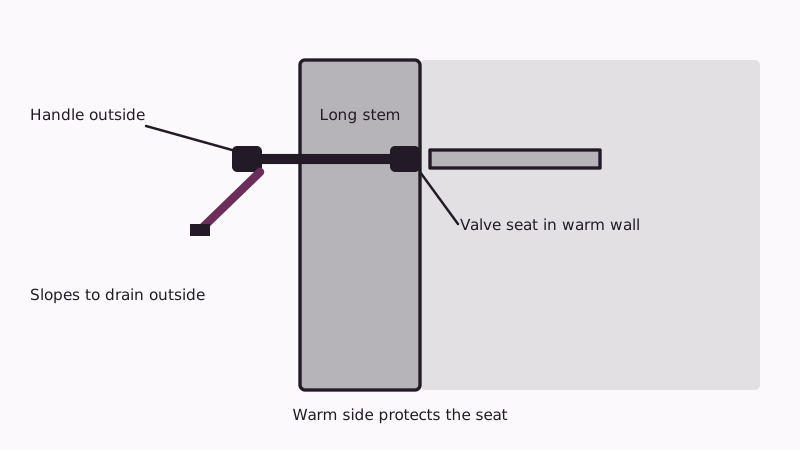
Hard freezes are rare in North Orange County, so plenty of houses here have ordinary spigots. Where a frost-free type is fitted and it drips inside the wall, the cause is often a hose left attached in cold weather, or a worn stem washer. Stains on the wall or damp insulation inside mean water is escaping behind the siding. Treat that as a replacement job and ring a plumber.
Is a slow drip worth the effort to fix?
Yes. EPA calculates that one drip per second loses upwards of 3,000 gallons annually, and it lists the hose connection at a spigot as a frequent household leak. Water running down siding or into a foundation also rots wood and leaves stains. Repair parts are cheap, and a simple washer swap is a short job.
Prefer not to do it yourself? A plumber can swap a bib in a short visit. Pass it on when the valve refuses to close, the pipe is corroded, moisture appears in the wall, or the spigot is soldered to copper. Describe the trouble on the quote page; a written estimate follows before any pipe is cut. Worn washers cause drips at other fixtures too; leaky shower faucets, tub faucets and indoor sink faucets follow the same logic.
Common questions
How quickly can this be fixed?
Snugging a packing nut takes minutes. A new washer or packing takes 20-45 minutes in published guides, including shutting off and draining. A full bib swap runs longer, especially when it is soldered or inside a wall, and a plumber may need an hour or two.
Is it safe to crank the handle nut harder?
No. A gentle quarter turn with the water on often ends a handle leak. If the handle stiffens or the seep continues, stop and repack the stem. Force can crush the packing and strip the brass, and a corroded nut is a sign to replace the faucet instead.
Why does it leak only with a hose on?
Usually the flat rubber washer inside the hose coupling has worn out or gone missing, so replace that first. If water still sprays, check the vacuum breaker and the spout threads. A hose left under pressure also strains the spigot, so take it off when you are done watering.
Does the water need to be off?
For anything past a nut adjustment, yes. Close the bib's own valve or the main and let the spigot run dry. Reassemble, then bring the water back slowly. A spigot with no valve of its own needs the main off, so locate it before starting.
Is this a plumber job or mine?
Often yours: a washer, packing or a vacuum breaker covers most leaks. Call one if new parts fail to seal it, the faucet is corroded, wetness appears in the wall or the supply valve will not shut. The plumber can also fit a dedicated shutoff, which makes the next repair easier.
This guide is one of many on plumber in Anaheim.
Sources
- US EPA WaterSense, Fix a Leak Week (leak sources and waste figures)
- City of Anaheim, water hardness (about 18 grains per gallon)
- Published hose bib repair guides from manufacturers and plumbing businesses, checked November 2026
Last updated