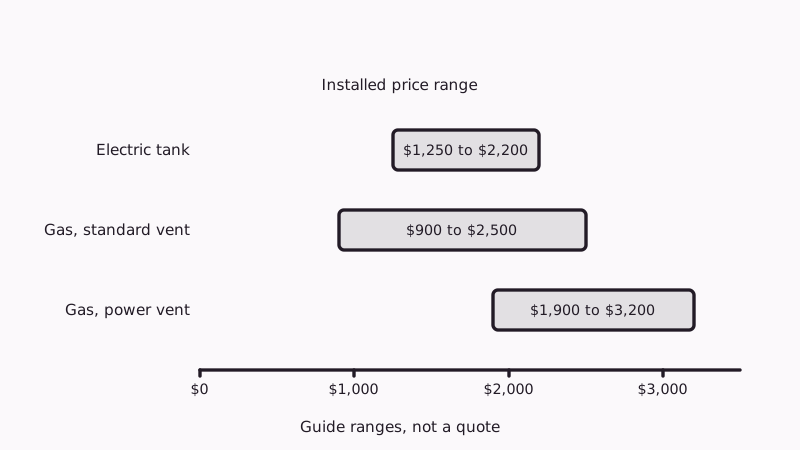
Two national guides agree on the shape of the number. Angi's July 2026 estimate puts a 50 gallon tank installed at about $800 to $2,500, and another cost guide gives $900 to $2,500 with $1,400 the figure it cites most. For a West Coast home the same guide says typical installs run about $1,700 to $2,700. Our water heater repair plumber page covers the repair side first.
How much money should I plan on for a 50 gallon unit?
National guides place a standard 50 gallon replacement at about $800 to $2,500 installed, and one of them shows West Coast jobs closer to $1,700 through $2,700. Electric tanks tend to sit at the low end, ordinary gas tanks mid-range, and power-vent gas models at the top. This is a guide, not an Anaheim quote.
| Type of 50 gallon heater | Typical installed range (guide) |
|---|---|
| Electric tank | $1,250 to $2,200 |
| Gas tank, standard vent | $900 to $2,500 |
| Gas tank, power vent | $1,900 to $3,200 |
These installed ranges come from one cost guide and the figures overlap, so the real difference between gas and electric is small compared with what the site conditions add.
What does the installed price cover?
A complete quote lists the tank, labor, a drain pan where required, a new relief valve plus a drain pipe, flex connectors, seismic straps, the permit, and taking the old tank off site. Go line by line. A cheap-looking quote that later swells almost always left some of these out.
Add-on ranges in the guides: labor roughly $300 to $900 for a basic swap, permit $50 to $200, expansion tank around $125 to $300, and removal $50 to $150 where it is not bundled. Angi says labor is close to half of the total. Ask who applies for the permit and whether disposal is included.
What makes a 50 gallon replacement cost more?
Cost climbs with venting changes, a gas line extension, a heater moved to a new spot, tight attic or closet access, a stuck shutoff valve, a new expansion tank and code upgrades. Electrical panel work on electric or heat-pump units can add much more. After-hours calls raise the price too.
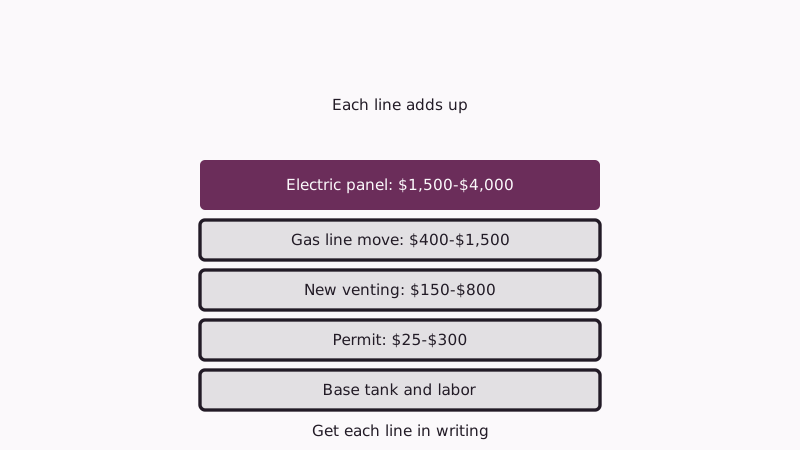
One guide prices new venting from $150 to $800, and moving the unit or running new gas line from $400 to $1,500. Another guide quotes an electric or hybrid panel upgrade between $1,500 and $4,000. Older houses in Anaheim, Fullerton and Orange tend to spring corroded valves, galvanized stubs and tight closets on the crew, which an on-site look can catch.
Does California require anything that adds cost?
Yes. Under section 19211 of the state Health and Safety Code, replacement and new heaters have to be secured against shaking, by bracing, anchoring or strapping. Cities also generally expect a permit, a relief-valve discharge pipe, and for gas, correct venting. A complete quote itemizes them.
Straps cost little beside the heater. In Anaheim, a heater change normally runs through the Building Division, so ask who applies for the permit; permit basics for water heaters lists what to confirm. Whatever the price, permitted work needs a contractor who holds a California license. Citrus Belt Plumbing arranges that visit.
Is a 50 gallon the right size for my home?
A household of three to five commonly runs a 50 gallon tank, though what matters is how much hot water gets used at the same moment. A 40 gallon heater is a bit cheaper and suits smaller homes. With a soaking tub or several showers going at once, stay at 50 or step up.
Compare with 40 gallon water heater replacement cost before you decide. Moving up in size also means checking that the closet or garage space and the gas line can handle it. A plumber can size it from your use.
Should I choose a tankless water heater instead?
Tankless installs cost more, at $1,400 through $3,900 in the same guide, and often mean a bigger gas pipe and a new vent. They free up space and never run out. A 50 gallon tank is cheaper at purchase and simpler to fit.
The comparison turns on your priorities. Read tank versus tankless and the tankless installation cost page. In hard water such as Anaheim's, which the City lists at about 18 grains per gallon, both types need regular flushing or descaling.
How can I compare two quotes honestly?
Put quotes side by side with the same size, fuel, venting and warranty terms, and check that each lists permit, strapping, expansion tank, haul-away and labor. A quote that looks several hundred dollars cheaper often leaves lines out. Any 50 gallon swap above $4,000 without a clear reason deserves a second look.
Warranty terms vary by model, so put the manufacturer's tank warranty and any labor coverage side by side in writing. The quote form starts a local visit with a price on paper. For broader pricing, see replacement costs for water heaters.
Common questions
What time should I allow for the swap?
Guides assume roughly 3 to 5 hours of labor, so a tank-for-tank swap commonly finishes within a morning or afternoon once the heater is on site. Relocation, new venting or panel work stretches that. The quote should name a time window.
Is gas or electric cheaper to replace?
Electric is often a bit cheaper to install, and gas is typically cheaper to run, depending on utility rates. The gap at install can be small. If your home has gas, swapping like for like avoids the cost of new gas lines or electrical panel work.
Is a permit required for the swap?
Usually. Most North Orange County cities treat a heater change as permitted work, and a permit means a California contractor license. Ask your city's Building Division, and have the permit fee and inspection written into the quote so nothing surprises you later.
What if my old heater still works but is old?
Replacing before it leaks can save water damage. Tank heaters typically last 8 to 12 years according to Rheem. If yours is past 10 years or shows rust or leaks, price a replacement now and choose the timing. Our how often water heater replacement page explains the signs.
Can I install a water heater myself?
Poor idea in California. A swap involves a permit, strapping, a relief valve with its drain, and on gas models a safe vent and gas hookup. Smell gas? Get outdoors and call SoCalGas (1-800-427-2200), or 911 if a person is in danger.
Sources
Last updated