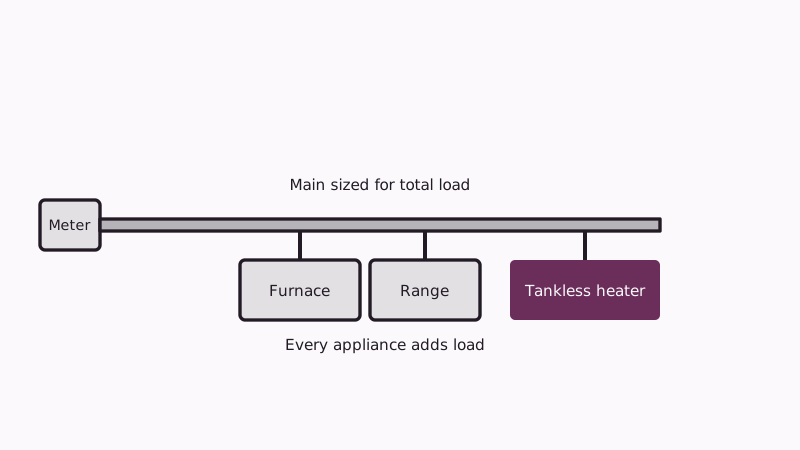
Rinnai makes several tankless families, and each model has its own manual, so the model number on the box decides the details below. What stays constant: the unit burns gas, so the gas pipe must carry enough, the exhaust must leave the house through approved vent pipe, and a condensing model drains acidic water that has to go somewhere. Part of a larger decision about replacing an old tank, the water heater service page outlines how we arrange these visits.
What does installing a Rinnai tankless unit involve?
A plumber hangs the unit on a wall, connects the water and gas lines, sends the exhaust pipe sideways out the wall or straight up out of the roof, pipes the condensate drain on a condensing model, wires power, then fills the system, leak tests it and sets the temperature. Rinnai's manuals say a trained, qualified professional must install and inspect it.
Rinnai's list of required skills covers gas pipe sizing, gas, water and electrical hookups, familiarity with local codes, getting a vent through a wall or roof, and tankless-specific training. That list is a fair test of a bid. Ask who will do each part and whether the quote covers all of them.
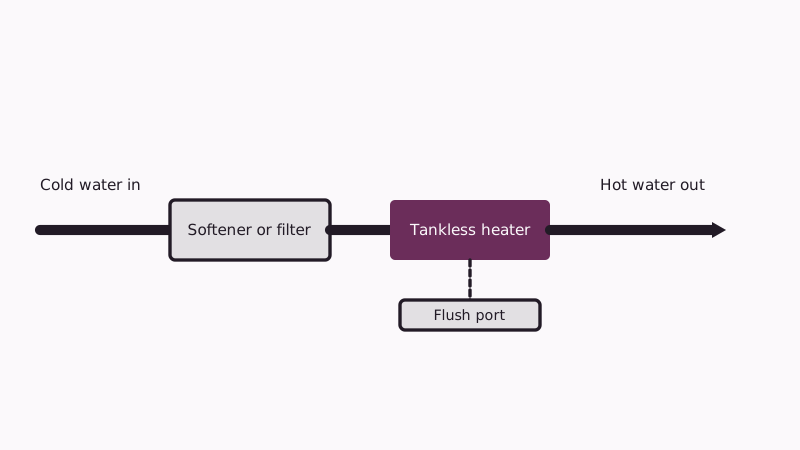
Isolation valves are not included in the box but Rinnai highly recommends them, since they let the unit be flushed and serviced later. Our overview of the gas tankless installation covers the common parts of any gas model, and the installation cost guide discusses the money side.
Will my gas line be big enough?
Often not, when replacing a tank. Rinnai's residential condensing manuals specify a three-quarter-inch gas connection and a supply pressure window of 3.5 to 10.5 inches of water column for natural gas. The manual does not name a single pipe size; the line must carry the whole load at that location, sized under the National Fuel Gas Code.
Federal energy guidance points out that a tankless burner is bigger, which can force a heavier gas line and fresh vent work in a retrofit. A plumber adds up every appliance on the line, measures the run and decides whether the existing pipe is enough. If it is not, the gas line is upsized, which is a permitted job in its own right. Our gas line plumber page explains that work. Should gas ever be detectable by smell, get outdoors first, and only then ring SoCalGas, whose emergency line is 1-800-427-2200.
How is the unit vented?
Rinnai requires approved vent pipe sized as the manual says, for example 2-inch and 4-inch concentric or 3-inch and 5-inch, with no reduction in diameter and no connection to an old chimney or another appliance's vent. Each condensing unit needs its own vent, with a termination at the height the manual specifies and a slight slope back toward the unit.
Maximum vent length depends on the model. Each manual gives a maximum vent length and counts every elbow as extra equivalent length, so a long run with several turns uses up the allowance quickly. Rinnai also says not to mix vent parts from different manufacturers. A room-air installation needs listed Category IV venting.
So the spot that once held a tank is not always an easy place for a tankless unit. The new vent route may cross a finished wall or the roof, and that adds to the price. Ask the plumber where the vent will exit and how far it is from windows and neighbors.
What happens to the condensate water?
Condensing models create acidic condensate. The manual specifies a half-inch drain connection and corrosion-resistant pipe such as PVC, with the open end in air, never submerged. It may not go straight into a rain sewer or an air conditioner coil drain. Local code governs how it is disposed of, so ask about a neutralizer.
Before the first start, the condensate collector has to be filled with water; the manual describes pouring water into the exhaust port. Skipping that step is one of the avoidable faults. Slope the drain properly and keep it from freezing, though freezing is a minor worry in most of Orange County.
What do Anaheim and Orange County homes add to the job?
In older Anaheim, Fullerton and Orange houses the tank commonly sits in a garage or closet, with galvanized steel or copper supply pipes plus gas piping that was sized only for a tank. Hard water is the other local factor: Anaheim's water-hardness page lists around 300 ppm, and scale can build in a heat exchanger, so plan for a service flush.
Hillside lots in Anaheim Hills may stretch the vent route and gas pipe. Postwar tract homes in Buena Park and La Habra frequently put the heater in the garage, where the vent run can stay short. Whichever you have, the plumber should see the site first.
Will the building department ask for paperwork?
Expect to need one. Anaheim's Building Division lists a replacement heater as permitted work, and neighboring cities treat it much the same, each with its own procedure. Tankless jobs bring gas and venting into the inspection. Permit rules for water heaters lays out what to expect before you sign.
On who does the work: the state contractor board files water heater and gas appliance installation under classification C-36, and a contractor license is mandatory once a job totals $1,000 of labor and parts. Ask the bidder about that class rather than a general handyman credential.
Is a Rinnai the right unit, or would another brand do?
Brand matters less than sizing, venting and upkeep. Compare flow rating against the number of fixtures you run at once, the efficiency and venting needs of each model, and the support available in your area. The Navien installation page walks the same steps for another maker's line, and tank versus tankless helps decide whether to switch at all.
If long waits for hot water bother you, a recirculation setup can help, as described in recirculation pump installation. To start a request, use the quote form.
Common questions
Could I do the install myself?
Rinnai's own manuals require a trained and qualified professional. California also puts gas piping and heater installation in the C-36 contractor class, with a city permit on top. An error in gas or venting can be dangerous, so DIY is a poor plan here.
Do Rinnai units need electricity?
Yes. They use power for controls, the fan and ignition, so most do not run during a blackout. Ask about a backup option if outages are a concern in your area. The manual for your model lists its electrical needs.
What is the time commitment?
A straightforward exchange can occupy most of a working day. New gas pipe, a changed vent route or wall repair adds to that. Request an estimate after the site visit, and note that the city inspection is booked separately from the visit.
What upkeep should I plan for?
Rinnai's manuals call for periodic servicing, and in hard-water areas, descaling the heat exchanger becomes a regular chore. Isolation valves make flushing far easier. Store the manual, the installer's details and the permit record together so that later service visits go smoothly.
This guide is one of many on plumber in Anaheim.
Sources
- Rinnai America, SENSEI RX residential installation and operation manual
- Rinnai America, N Series residential condensing installation and operation manual
- U.S. Department of Energy, Strategy Guideline: Proper Water Heater Selection
- Contractors State License Board, C-36 Plumbing Contractor classification
Last updated