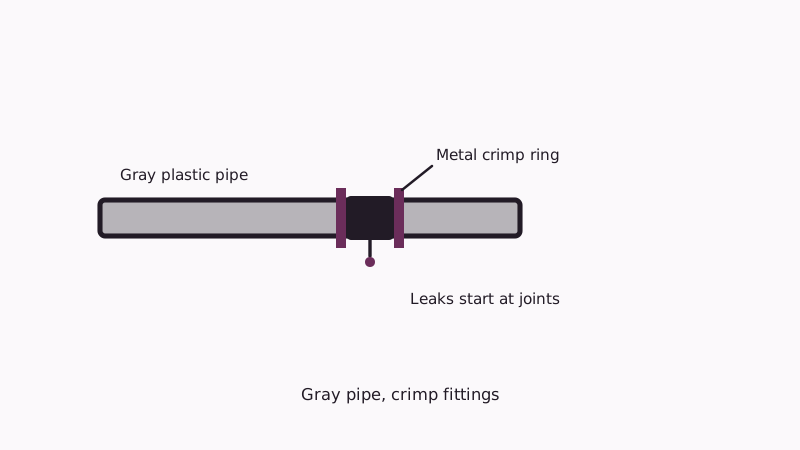
If your house went up sometime from the late seventies to the middle nineties and has gray plastic water lines with metal or plastic fittings, check for polybutylene. It has a history of leaking at joints, sometimes slowly and sometimes in a sudden burst, and Wikipedia reports that the only long-term fix is replacing it throughout. That is a house repipe, and this page explains what it involves and whether it is worth doing.
What is polybutylene, and does my Southern California house have it?
Polybutylene (PB) is a flexible plastic water supply pipe that went into some millions of homes across the US and Canada, roughly 1978 through 1997 by Wikipedia's count. It is no longer accepted under US building codes. Houses from the 1980s and early 1990s are the likeliest, so newer Southern California subdivisions are more likely to have it than older ones.
Look at exposed pipe near the water heater, under sinks, in the garage or in the attic. PB is typically gray, and the American Society of Home Inspectors describes the gray pipe and metal ring at connections, plus piles of removed fittings and crimp rings as evidence of past repairs. The pipe is usually stamped with a code that includes "PB". Tract homes from the 1950s and early 1960s, common in Buena Park, La Habra and Placentia, more often carry galvanized steel prone to internal rust, or copper; see galvanized pipe replacement.
If you cannot tell, a plumber or home inspector can confirm in a short visit.
Why does polybutylene fail?
Wikipedia says disinfectants such as chlorine and chloramine in city water can break down the pipe's internal structure, and stress speeds this up, which is why failures cluster at fittings, sharp bends and kinks. The fittings also suffer, since the associated acetal fittings are affected by chlorinated water too.
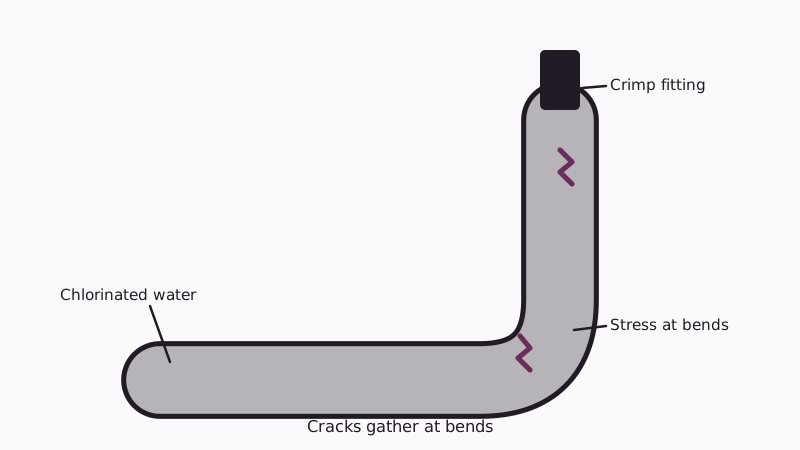
Failures can be slow leaks or sudden bursts with little warning. ASHI puts the question as one of timing rather than possibility: "It's no longer a matter of 'if' the pipes will leak, but 'when.'" It also notes that crimped connections can be made badly, and that "PB doesn't tolerate abuse well". A pinhole behind drywall can run for days before a stain appears, which is why the damage is often larger than the repair.
Is it worth replacing, or can I wait?
For most owners the answer is yes, replace, particularly if the house has had any PB leak, you plan to stay for years, or you want insurance or a sale to go smoothly. Waiting trades a planned project for the chance of a surprise flood. A house with no leaks yet is not necessarily a safe one.
Points that weigh in:
- Leak history. Any leak at a fitting suggests more to come.
- Insurance. ASHI reports some hazard insurers back away from PB-piped homes and that policies have been canceled after major claims. Ask your insurer what it requires.
- Selling. Buyers' inspectors flag PB, and a repipe can remove an obstacle. Ask a real estate agent how it is handled in your transaction.
- Timing. Doing the work before a leak lets you pick the contractor, schedule and finish materials instead of reacting.
- Cost. A repipe is one of the larger plumbing projects, so it is an expensive project worth comparing quotes on. Pricing is covered under whole-house repipe cost and PEX repipe pricing.
Is there a polybutylene replacement program or settlement fund?
Not any more. The Cox v. Shell Oil class action, filed in 1995, ended in a settlement of roughly $1 billion, Wikipedia says. Published reports say that claims stopped being accepted in 2009. No program is open today as far as the sources checked here show.
Do not take any website's word for it either way: ask your insurer or an attorney if you believe you have a claim. Some homeowners keep a copy of an old claim number or paperwork from a prior owner, and that may be worth bringing up with an attorney.
What does a polybutylene repipe involve in Southern California?
A plumber surveys the house, cuts small access openings in walls and ceilings, pulls in new supply lines, reconnects fixtures, then patches the access holes. Most repipes use PEX or copper. Plan on several days, a city permit with its inspection, and hours without water on each of them.
PEX, Wikipedia says, is approved across the US and Canada, is less prone to bursting when water freezes than copper, degrades in sunlight, and contains additives that help it resist chlorine. Copper has its own track record and costs more. Whichever you choose, ask how fittings are made, who patches drywall and paint, and how the old pipe is handled; a side-by-side of PEX and copper weighs them.
Homes with attics or crawl spaces are easier to repipe than slab houses with fewer paths; see slab repipe options. The repiping walkthrough lays out the sequence. California makes a contractor license mandatory from a $1,000 total, a figure a repipe will almost certainly pass. Get the contractor's license number up front and verify it on the state board's site.
How do I protect the house until the repipe happens?
Confirm that you know where the main shutoff sits and that it actually turns. Check under sinks, around the water heater and in the attic or crawl space now and then for stains or drips. EPA's meter test helps: record the dial, leave every fixture idle for about two hours, then check it again; a changed number signals a leak.
Some owners fit a shutoff or leak sensors, which is a decision to talk through with the plumber. Should a PB line burst, turn off the main valve, drain the system through a low faucet, and ring a plumber. Photograph damage for your insurer. See leaking pipe repair and slab leak detection for related cases.
Common questions
Is polybutylene always going to fail?
Not every pipe leaks, and some PB homes go years without a problem, but the failure mechanism is built into the material and its fittings, and ASHI describes the question as when, not if. Many owners treat it as a project to schedule rather than an emergency to wait for.
Could my insurer drop me over this kind of pipe?
Some insurers have restricted coverage on PB-piped homes, and ASHI reports cancellations following major claims, so this is worth settling early. Policies differ, so ask the insurer in writing, and save records of any replacement work for your next renewal or sale.
Can I replace just part of it?
Partial replacement is possible, for example one bathroom or the section near the water heater, but the remaining PB stays at risk. Wikipedia says the long-term fix is replacing the PB throughout. Ask the plumber what a partial job would cost and what it leaves behind.
Which is better after PB, PEX or copper?
Both are used, and the choice depends on budget, access and preference. PEX is approved across the US and Canada and resists chlorine through additives, while copper costs more. Compare quotes for each. Our quote page starts a visit, and the plumber should explain both options in writing.
This guide is one of many on Anaheim plumber.
Sources
- Polybutylene, Wikipedia (use, failure mechanism, building code status, lawsuit)
- American Society of Home Inspectors, More on PB Piping
- Cross-linked polyethylene, Wikipedia
- Published reports on the Cox v. Shell Oil polybutylene settlement (claims closed 2009)
- California Contractors State License Board, hire a contractor
Last updated